

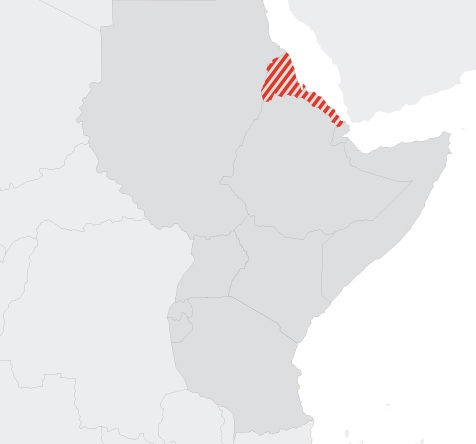
Eritrea: Do Not Create a Precedent, Maintain HRC Scrutiny
All States should oppose attempts to discontinue the Special Rapporteur’s mandate
As a group of over 30 civil society organisations showed ahead of the current HRC session, HRC59 (16 June-9 July 2025), Eritrea’s human rights situation has not fundamentally changed since the completion of the work of the Commission of Inquiry, in 2016. Grave violations are ongoing and impunity remains widespread.
By any standard, Eritrea remains among the most serious situations on the African continent. In 2025, for the second year in a row, the country has been ranked last (180th/180) in Reporters Without Borders’ World Press Freedom Index (WPFI).
Yet, in an attempt to free-ride on both the UN’s liquidity crisis and attacks against multilateralism, the Eritrean Government is presenting its own resolution to end international scrutiny.
This draft resolution, tabled at 10:00am on the opening day of HRC59, under agenda item 2 (to make sure its reference would be L.1, meaning it would be considered first during the voting process), does not conceal its objective: it is entitled “Discontinuation of the Mandate of the Special Rapporteur on the Situation of Human Rights in Eritrea.” It seeks to end this vital mandate and requests the Government to “fully cooperate with all international human rights mechanisms […] with a view to strengthening the promotion and protection of human rights in the country.”
This is surprising, to say the least, given Eritrea’s track-record of non-cooperation, including during the time of its Council membership (2019-2024).[1] As the Council approaches 20, Eritrea remains among the very few countries that have never received any visit by a special procedure.
This attack against a mandate that was created at the initiative of African States (Djibouti and Somalia, with the support of Nigeria), in 2012, and extended by consensus, under item 4, until 2018 (before being taken up by a group of States, and later the European Union, and moved to item 2) is unprecedented.[2] In the past, Eritrea tried to discontinue the mandate or divert attention from its human rights record by requesting votes on key paragraphs of the text (at HRC41, in July 2019) or tabling (and later withdrawing) a draft resolution on the human rights situation in Ethiopia (at HRC35, in June 2017).
This time, if the Eritrean side does not withdraw its initiative before the voting process, we call on all States to vote “No” and reject L.1 unambiguously.
~ ~ ~
Abstention, in this regard, is not enough. Any State that plans to either vote “Yes” or abstain on the draft resolution seeking to extend the Special Rapporteur’s mandate should vote “No” on the other draft resolution, tabled by Eritrea. The two initiatives are nothing like the parallel initiatives on South Sudan we see at March sessions – both South Sudan resolutions can pass without a major consistency issue. The two Eritrea-focused initiatives, however, are mutually exclusive.
For States that support the mandate extension, the equation is clear: they should vote “No” to L.1.
For States that, for a number of reasons, abstain on the mandate extension, the equation is not much more complex. Their position (abstention) means that they do not wish to be an obstacle to the Special Rapporteur’s work. On the other hand, abstaining on L.1 would mean that they do not wish to be an obstacle to the end of the Special Rapporteur’s work. This is a policy coherence issue. To be consistent, they should vote “No” to L.1.
If L.1 goes to a vote, on 7 July, the difference between “No” and “Yes” votes will be key. The margin should be as broad as possible (and abstentions as few as possible) to:
- Preserve the only mechanism tasked with monitoring and reporting on Eritrea’s human rights situation,[3] providing a lifeline to victims and survivors of Eritrea’s abuses, including within the diaspora;
- Make sure such initiatives do not appear again in future sessions; and
- Deter other States that are under the Council’s scrutiny (through special procedure mandates or independent investigations) from doing the same – Nicaragua, Russia, Sudan or others may be tempted to use the same trick as Eritrea to discontinue mechanisms addressing their own situation.
~ ~ ~
For the Eritrean authorities, there is a simple way of phasing out the Special Rapporteur’s mandate: Uphold the rights of your citizens, address the issues that led 18% of the population to vote with their feet and flee the country, and meaningfully cooperate with the Council and its mechanisms – you cannot pick and choose among them.
Hassan Shire
Executive Director, DefendDefenders
Chairperson, AfricanDefenders
[1] HRC resolutions and resolutions and decisions of the African Commission on Human and Peoples’ Rights (ACHPR) remain unimplemented. For references, see DefendDefenders et al., “Eritrea: Extend UN Rapporteur mandate through a substantive resolution,” 28 May 2024, https://defenddefenders.org/eritrea-extend-sr-mandate-substantive-resolution/
[2] See Human Rights Concern – Eritrea, “Eritrea: The Special Rapporteur’s mandate was not established in response to the political situation in the Horn of Africa, but to address the egregious human rights violations committed by the Eritrean government against Eritrean civilians,” 10 July 2019, https://hrc-eritrea.org/eritrea-the-special-rapporteurs-mandate-was-not-established-in-response-to-the-political-situation-in-the-horn-of-africa-but-to-address-the-egregious-human-rights-violations-committed-by-th/; as well as the Annex to the 2023 civil society letter, DefendDefenders et al., “Eritrea: The UN Human Rights Council should adopt a strong resolution,” 17 May 2023, https://defenddefenders.org/eritrea-hrc-strong-resolution-2023/
[3] “Cost-saving-” or “efficiency-” related arguments are disingenuous. Program budget implications (PBIs) associated with the Special Rapporteur’s mandate are modest, as the mandate-holder is assisted by one P3-level staff member.
Download this opinion piece in English.
Version française (en PDF) : « Érythrée : Ne créez pas de précédent, maintenez la surveillance du CDH ».