

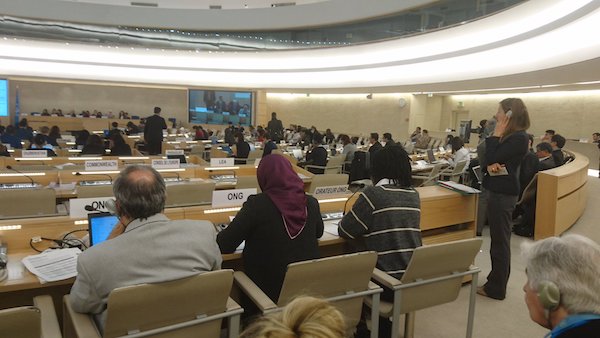
The start of the 38th session was marked by an unprecedented event, as the United States withdrew its membership from the UN Human Rights Council (UN HRC). It is the only state to have done so in the Council’s twelve-year history. In a letter, sent on 22 June, Ambassador Nikki Haley accused DefendDefenders (the East and Horn of Africa Human Rights Defenders Project) and 17 other NGOs of having contributed to that decision, after we co-signed a letter expressing legitimate concerns about US efforts to reform the UN HRC at the UN General Assembly, which bypassed established processes.
Although we welcome attempts to strengthen the Council, we had serious concerns that this approach would have weakened it. DefendDefenders is committed to the UN HRC as a forum where voices of human rights defenders (HRDs) can be heard, and we supported HRDs from Eritrea and Tanzania to attend the 38th session.
Burundi featured prominently on the agenda, with examinations under Item 4, Item 6 (Universal Periodic Review), and Item 2. During the session, the delegation continued the non-cooperation that has come to define Burundi’s tenure as a member state, going so far as to threaten legal action against members of the Commission of Inquiry (CoI) on Burundi. In a Kafkaesque move, the government issued and then revoked the visas of three human rights experts mandated by a resolution it had supported during the Council’s 36th session. Nevertheless, the CoI has been able to collect over 880 testimonials, documenting violations including extrajudicial executions, enforced disappearances, and torture and other forms of ill-treatment.
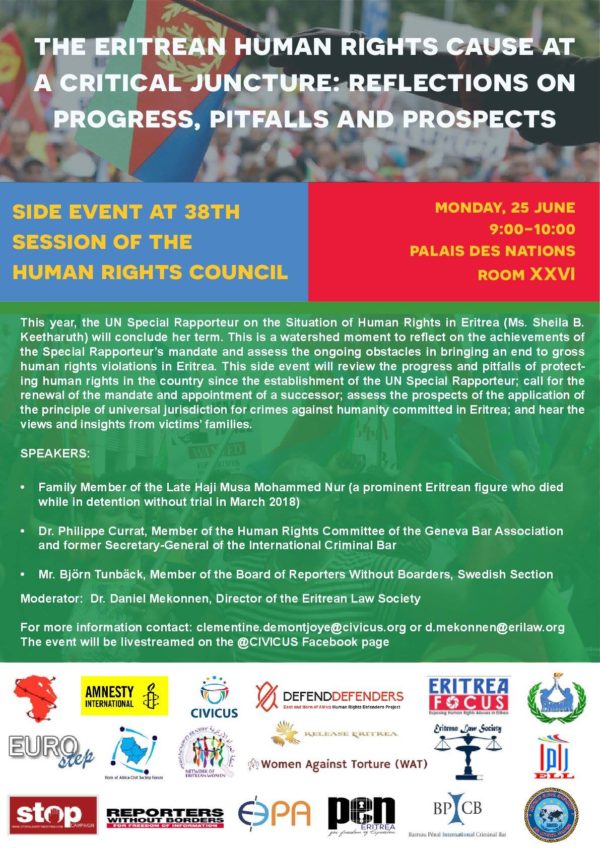
Eritrea similarly refuses to cooperate with mechanisms of the UN HRC and the Office of the High Commissioner for Human Rights (OHCHR). DefendDefenders co-hosted a side-event that discussed options as the mandate of the UN Special Rapporteur on Eritrea came to an end. We welcomed the Council’s decision to extend the mandate, and laid out several options for the new mandate-holder ahead of the session, focusing on ways to advance accountability for the crimes under international law and violations of human rights.
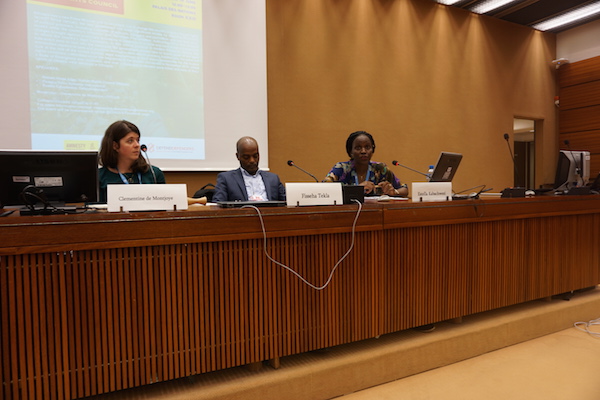
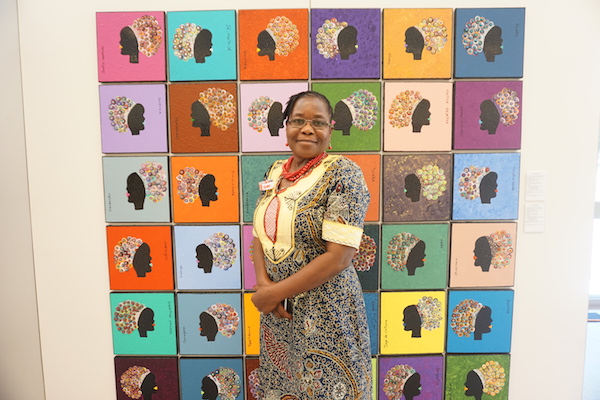
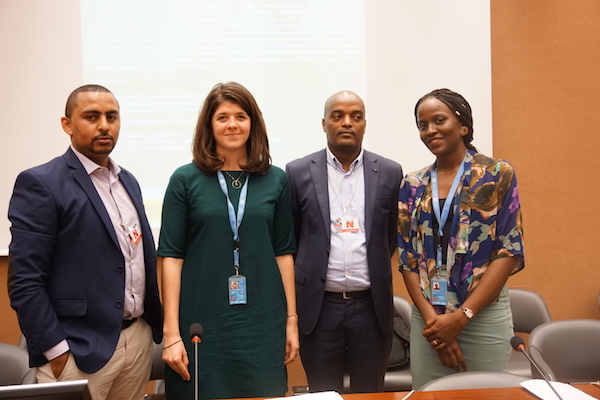
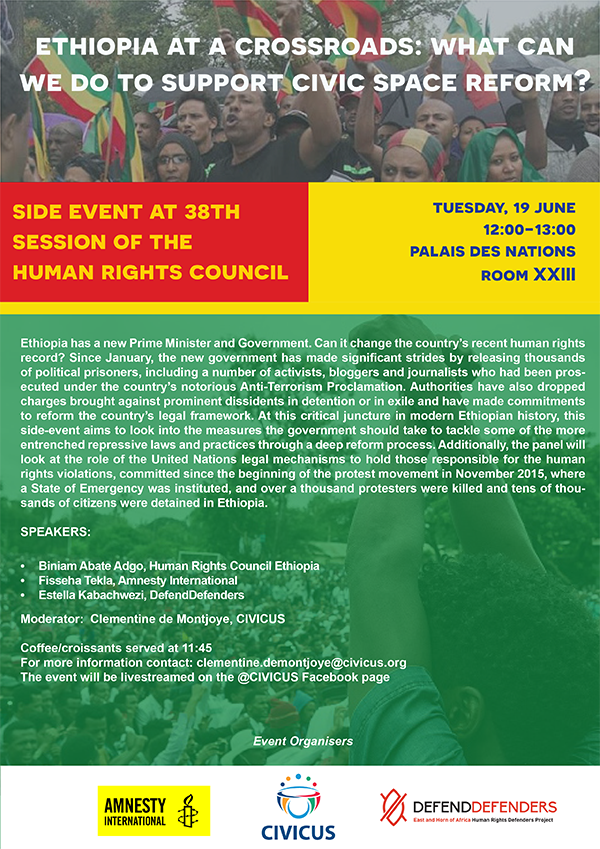
Ethiopia has seen remarkable positive change since Abiy Ahmed took office as Prime Minister in April 2018. Now that the state of emergency has been lifted, thousands of political prisoners have been released, and authorities have signaled a willingness to review repressive laws, the country finds itself at a critical junction. Although the Prime Minister conceded security forces have committed violations during the mass protests that have rocked Ethiopia since November 2015, the perpetrators are yet to be brought to justice. During a side-event, DefendDefenders joined other panelists to look at the possible role of regional and international mechanisms to ensure accountability and that systemic human rights issues are addressed.
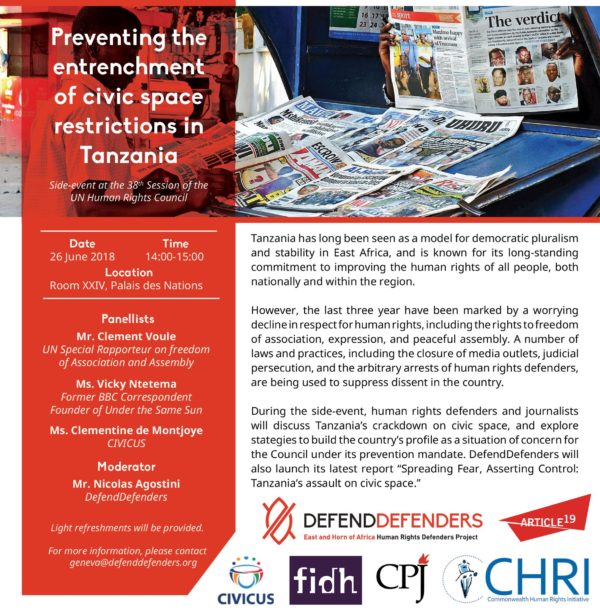
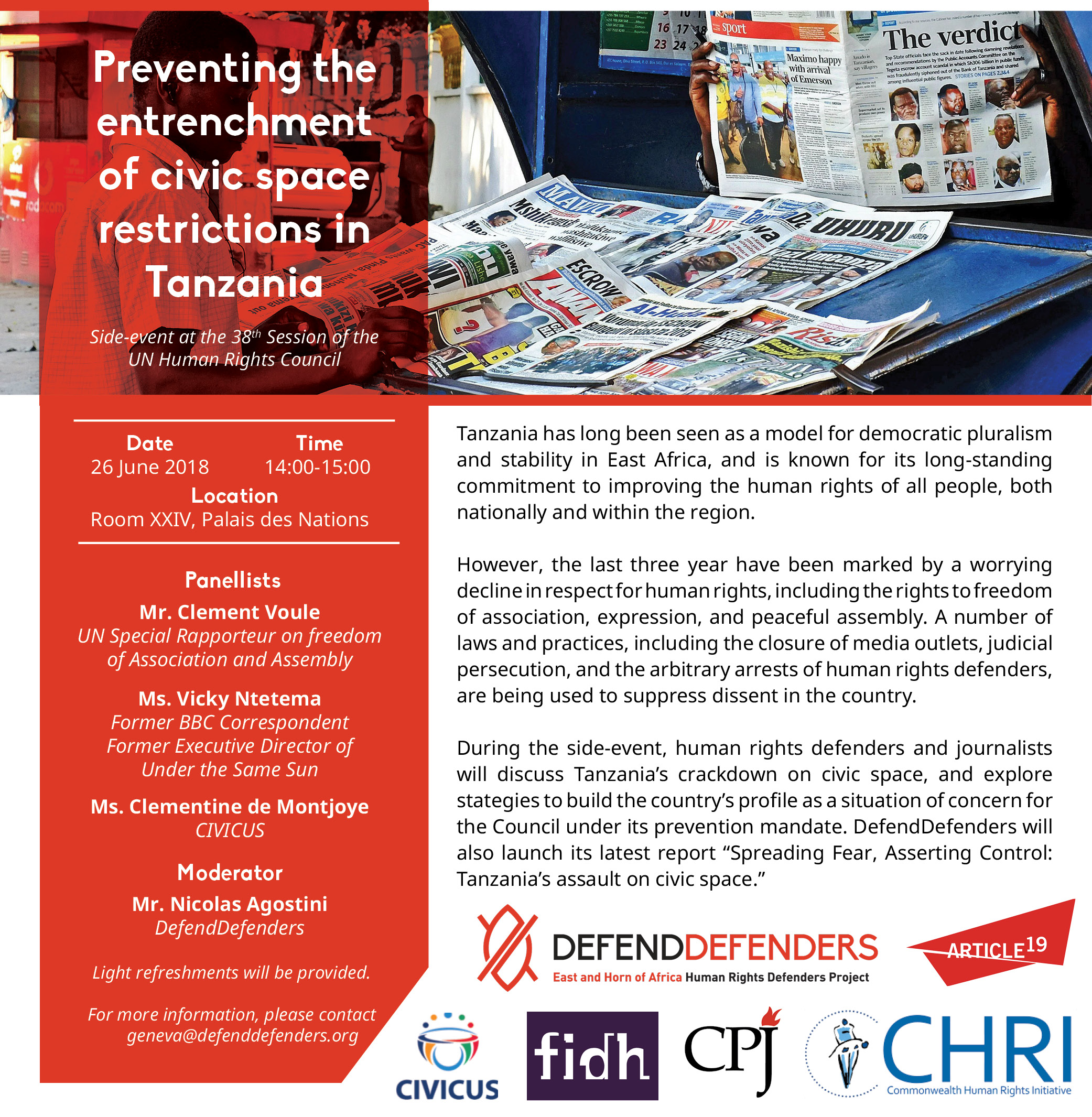
On the other hand, in Tanzania, authorities have grown increasingly intolerant of critical voices ever since President John Magufuli took office in October 2015. DefendDefenders organised a side-event during which the panellists launched Spreading Fear, Asserting Control: Tanzania’s assault on civic space, our latest report based on a research mission conducted three weeks before the session, to highlight the increasing judicial and extra-judicial restrictions placed on HRDs, bloggers, and journalists. Focusing on the Council’s prevention mandate, participants explored avenues for the UN HRC to avert entrenchment of the current crisis.
We welcomed the presence of the Tanzanian delegation at the event, particularly the invitation for a country visit the Tanzanian Ambassador extended to the Special Rapporteur on freedom of association and peaceful assembly. During the General Debate under Item 4, we called upon the government to formalize this invitation without delay.
On thematic areas, DefendDefenders highlighted the crackdown on journalists in the self-declared Republic of Somaliland, where journalist, artists, and media professionals have been repeatedly charged and convicted on spurious charges. With landmark resolution A/HRC/32/2, which created the mandate for the Independent Expert on minorities, the UN HRC recognized a community that remains particularly vulnerable in the East and Horn of Africa, and DefendDefenders expressed its concern about the undue restrictions HRDs working on minority issues in Tanzania and Uganda continue to face.
Oral Statements to the Council
Mr. President,
On behalf of DefendDefenders (the East and Horn of Africa Human Rights Defenders Project), I would like to extend my warmest congratulations to Mr. Clément Voulé for his appointment as UN Special Rapporteur. We welcome his first report, including his analysis that patterns of attacks against the civic space around the globe have resulted in serious limitations to the exercise of the rights to freedom of peaceful assembly and association. This holds true for minority persons, defenders and organisations, who are particularly vulnerable to physical attacks and at risk of arrest, detention and harassment, both from the authorities and non-state actors.
As highlighted by Independent Expert Victor Madrigal-Borloz, deeply entrenched stigma and prejudice on the basis of minority, reinforced by discriminatory laws and regulations foster a climate where hate speech, violence and discrimination are condoned and perpetrated with impunity. The media often amplify and disseminate messages that foster this climate.
Across the East and Horn of Africa, violent illegal acts by police and other actors targeting the minority community are all too frequent. In Tanzania, as President Magufuli’s rule has taken on a moralistic tone, the situation of minority persons and HRDs working on minority issues has become increasingly precarious. On 17 October 2017, a legal consultation organised by local NGO CHESA and South Africa-based ISLA was raided by police in Dar es Salaam. CHESA was immediately suspended. The status of the investigation, the legal status of the case, and CHESA’s registration status remain unclear. The case against CHESA has no legal basis, as “promotion of homosexuality,” of which members have been accused, is not an offence under Tanzanian law. As one HRD DefendDefenders interviewed last month said: “Our existence bothers some people.”
In Uganda, in the last few years, Pride Uganda celebrations have been shut down, affecting Ugandans’ rights to peaceful association and assembly. In a recent instance, celebrations to mark the International Day Against Homophobia, Transphobia and Biphobia were shut down by Uganda’s Minister of Ethics and Integrity.
We call on the Tanzanian and Ugandan authorities to reverse course and fully respect freedom of peaceful assembly and association, including of minority persons, defenders and organisations and to publicly commit to bringing impunity for acts of violence and discrimination against them to an end.
Mr. President,
DefendDefenders (the East and Horn of Africa Human Rights Defenders Project) welcomes the reports of the Special Rapporteurs on extrajudicial, summary or arbitrary executions, on armed non-State actors, and on the right to freedom of opinion and expression.
Mr. Kaye,
We agree with you on the principle that any framework for the moderation of content, including online, must be human rights-based. We are concerned that legitimate discourse is increasingly targeted, including through requests for pre-publication monitoring and filtering on online platforms such as forums and blogs. We will deliver further remarks on the situation in Tanzania under another agenda item.
Governments across the East and Horn of Africa have sought to restrict legitimate expression. For instance, in Kenya, on 26 March 2018, journalists from several media houses were threatened and beaten at Jomo Kenyatta International Airport while attempting to cover the return of opposition figure Miguna Miguna. This incident follows the suspension, on 30 January 2018, of three TV stations and several local radio stations after they reported on the unofficial swearing-in of then-opposition leader Raila Odinga. By 9 February, all stations were again available on free-to-air platforms, but the incident had a chilling effect.
In the self-declared Republic of Somaliland journalists, artists, and media professionals have been harassed. On 6 March 2018, poet and peace activist Naema Qorane was charged with spreading “unpatriotic propaganda” via Facebook, where she allegedly promoted the idea of a united Somalia. On 15 April, she was sentenced to three years in jail on charges of “anti-national activity of a citizen and bringing the nation or state in contempt,” and later pardoned.
In South Sudan, the Media Authority suspended UNMISS-operated Radio Miraya for a allegedly failing to comply with national media laws. On 19 April, authorities shut down the BBC’s FM relay stations in the cities of Juba and Wau, alleging that the broadcaster had failed to pay certain bills.
Lastly, we close this statement by expressing hope that the steps the new Ethiopian government has taken and will take, including reviewing the Anti-Terrorism and Civil Society Proclamations, will lead to an enlargement of the civic space, as a free space where citizens can peacefully express their views and share grievances is a precondition for sustainable development.
Thank you for your attention.
Mr. President, Madam Special Rapporteur,
We thank you for your final report to the Human Rights Council, which outlines that the situation in Eritrea remains grim, with no meaningful progress to report. We salute you for the tremendous work you have carried out over the last six years. It is of utmost importance for the Council to remain seized of the situation under its agenda item 4 and to keep on shining a light on the plight of the Eritrean people. We call on the Council to extend the dedicated country mechanism.
I now turn to the Eritrean government. While we note that appalling verbal attacks against UN experts, some of which verged on incitement to physical violence, we witnessed in the last few years seem to have stopped, we reiterate that the human rights violations for which the government is responsible, some of which may amount to crimes against humanity, call for accountability. We urge all states that are willing to exercise jurisdiction over Eritrean cases to do so, including through the use of universal jurisdiction for crimes under international law.
Regarding engagement with the UN, the ball is in the government’s court. Supporting your claim that there has been “opening” and “positive change” would not take much. A number of steps can be taken immediately. They include:
– Inviting the Special Rapporteur for a visit to the country, with unfettered access to training camps and detention places;
– Accepting pending visits requests by special procedure mandate holders, including on civil and political rights;
– Immediately and unconditionally releasing all political prisoners, including journalists and human rights defenders, as well as those who have attempted to evade national service or flee the country; and
– Putting an end to indefinite national service, which constitutes enslavement.
A wind of change may well be blowing in the region. DefendDefenders urges you to change course, seize the hand that seems to have been extended by Ethiopia regarding the border issue, and prioritise respect for the human rights of your citizens, including their right to accountability and redress.
Thank you for your attention.
Mr. President, members of the Commission of Inquiry,
We thank you for your update. Since the beginning of the crisis, civil liberties have been severely restricted in Burundi. A large number of human rights defenders (HRDs) remain in exile. Independent journalists, lawyers and members of human rights organisations maintain their work while in exile, but in a precarious environment.
In the country, assault on civic space is the new normality. In May, the government suspended radio broadcasts from the BBC and Voice of America. HRDs who are still present are under constant pressure, or facing arrest. Germain Rukuki, Emmanuel Nshimirimana, Aimé Constant Gatore, and Marius Nizigama have been sentenced to prison terms between 10 and 32 years as reprisals for their human rights work, while Nestor Nibitanga may face 20 years. We are particularly concerned about the physical condition of Germain Rukuki, who needs medical care. Just like hundreds of Burundians, HRDs are also victims of enforced disappearances, like Marie-Claudette Kwizera, Treasurer of the Ligue Iteka, who disappeared on 10 December 2015 and whose fate or whereabouts remain unknown.
On 17 May 2018, Burundi held a controversial constitutional referendum. The electoral process was marred with violence and repression, with arrests, beatings and intimidation of citizens campaigning for a “No” vote.
Mr. President,
From the start, Burundi was unfit to serve as a Council member. In the last two-and-a-half years, its behaviour on this Council has been appalling. Burundi has attempted to weaken the Council and its mechanisms, including the Commission of Inquiry. The multiple statements the government made to boast of its unwillingness to cooperate should have triggered action with regard to its membership rights. As a matter of principle, we reiterate that it is not too late for the Council to recommend that the UN General Assembly suspend Burundi.
Thank you for your attention.
Monsieur le Président, chers membres de la Commission d’enquête,
Nous vous remercions pour votre mise à jour. Depuis le début de la crise, les libertés civiles ont été sévèrement restreintes au Burundi. Un grand nombre de défenseurs des droits humains (DDH) se trouvent en exil. Journalistes indépendants, avocats et membres d’organisations de défense des droits humains poursuivent leur travail depuis l’étranger, mais dans des conditions précaires.
À travers le pays, les attaques contre l’espace civique sont la nouvelle normalité. En mai, le gouvernement a suspendu les transmissions radio de la BBC et de Voice of America. Les DDH qui sont toujours présents dans le pays sont sous pression permanente ou sous la menace d’arrestations. Germain Rukuki, Emmanuel Nshimirimana, Aimé Constant Gatore et Marius Nizigama ont été condamnés à des peines allant de 10 à 32 ans en représailles à leur travail en faveur des droits humains. Nestor Nibitanga risque, lui, une peine de vingt années. Nous sommes particulièrement inquiets quant à la condition physique de Germain Rukuki, qui a besoin de soins médicaux. Comme des centaines de Burundais, les DDH sont aussi victimes de disparitions forcées. Ainsi de Marie-Claudette Kwizera, trésorière de la Ligue Iteka, qui a disparu le 10 décembre 2015 et dont le sort demeure inconnu.
Le 17 mai 2018, le Burundi a tenu un référendum constitutionnel controversé. Le processus électoral a été marqué par la violence et la répression, avec des arrestations, des tabassages et l’intimidation des citoyens faisant campagne pour le « non ».
Monsieur le Président,
Dès l’origine, le Burundi n’était pas apte à servir comme membre du Conseil. Au cours des deux années et demi passées, son comportement dans cette enceinte a été consternant. Le Burundi a tenté d’affaiblir le Conseil et ses mécanismes, dont la Commission d’enquête. Les multiples interventions que le gouvernement a livrées, se vantant de son refus de coopérer,auraient dû déclencher l’action des États quant à ses droits de membre élu. Par principe, nous réitérons qu’il n’est pas trop tard pour le Conseil de recommander à l’Assemblée générale de l’ONU de suspendre le Burundi.
Je vous remercie de votre attention.
Mr. Vice president,
We would like to draw the Council’s attention to the situation in Tanzania, which increasingly resembles a case of needed preventative action.
Since 2015, Tanzania has taken a series of steps to restrict civic space and its citizens’ fundamental rights. Media outlets have been shut down or suspended. Human rights defenders (HRDs) have been harassed, threatened, and stigmatised. NGOs, including those working on LGBTI issues, have been arbitrarily suspended or de-registered. Members of the opposition, including MPs, have been assaulted and killed. The fate or whereabouts of journalist Azory Gwanda, who disappeared in November 2017, remain unknown.
The Media Services Act, the Cybercrimes Act, the Statistics Act and other laws, which have been used to silence independent voices, should be reviewed and amended in line with Tanzania’s domestic and international obligations.
We call on member and observer states to send the Tanzanian government a message, including through joint statements, that this trend should be put to an end. We welcome Tanzania’s invitation to the Special Rapporteur on freedom of peaceful assembly and of association, made yesterday at a side event, and call on the government to swiftly set a date for a visit.
Mr. Vice president,
Sudan continues to put a strain on this Council’s time and resources by abusing agenda item 10, which is dedicated to technical assistance and capacity-building. What Sudan needs is political will to improve the situation and bring impunity to an end, not more technical support.
In the last few months, HRDs, opposition members, and students have been arbitrarily arrested, ill-treated, banned from traveling, or detained incommunicado by the National Intelligence and Security Services (NISS) in connection with anti-austerity protests and other public gatherings. Sexual violence remains widespread, in conflict and non-conflict zones, and continues to be used as a weapon of war.
We urge the immediate and unconditional release of Noura Hussein, a victim of child marriage and marital rape, who was sentenced to five years’ imprisonment and a fine for killing her husband in self-defence.
Thank you for your attention.
Mr. President,
DefendDefenders (the East and Horn of Africa Human Rights Defenders Project) takes note of Burundi’s replies to the recommendations received during its UPR. We regret the government’s unwillingness to ratify key international instruments such as Optional Protocol to the International Covenant on Economic, Social and Cultural Rights, the International Convention for the Protection of All Persons from Enforced Disappearance, and the Rome Statute of the International Criminal Court, from which the government withdrew in an attempt to evade accountability for crimes under international law.
The government continues to defy the UN human rights system. In its responses ahead of today’s meeting, it dedicated a mere two paragraphs to the 34 recommendations on cooperation with the Office of the UN High Commissioner for Human Rights (OHCHR) and the Commission of Inquiry (CoI) set up by this Council to investigate the human rights violations and abuses committed since April 2015. We consider that this is yet another insult to the victims.
The government’s rejection of recommendations pertaining to the fight against impunity, in particular of the ruling CNDD-FDD youths, or Imbonerakure, and to freedoms of expression, peaceful assembly and association, is particularly telling.
Lastly, we condemn the pattern of reprisals meted out by the government of Burundi against human rights defenders who cooperate with the United Nations, its representatives and mechanisms. I close by quoting from a recommendation, offered by Ghana, which the Burundian government rejected: “Investigate all alleged reports of violence against, and intimidation, harassment and surveillance of, human rights defenders, and conduct prompt and impartial investigations with a view to holding the perpetrators accountable” (137.169). This behaviour, Mr. President, is nothing other than an attack against the UN human rights system as a whole.
Thank you for your attention.
Monsieur le Président,
DefendDefenders (the East and Horn of Africa Human Rights Defenders Project) prend note des réponses du Burundi aux recommandations reçues lors de son EPU. Nous regrettons le manque de volonté du gouvernement de ratifier des instruments internationaux clefs tels que le Protocole facultatif au Pacte international relatif aux droits économiques, sociaux et culturels, la Convention internationale pour la protection de toutes les personnes contre les disparitions forcées et le Statut de Rome de la Cour pénale internationale, dont le gouvernement s’est retiré dans une tentative d’échapper à ses responsabilités pour les crimes internationaux commis.
Le gouvernement continue de défier le système onusien des droits humains. Dans les réponses qu’il a fournies en amont de la réunion d’aujourd’hui, il a dédié seulement deux paragraphes aux 34 recommandations concernant la coopération avec le Bureau du Haut-Commissaire aux droits de l’homme (HCDH) et la Commission d’enquête mise en place par ce Conseil pour faire la lumière sur les violations et atteintes commises depuis avril 2015. Nous considérons qu’il s’agit là d’une insulte supplémentaire aux victimes.
Le rejet par le gouvernement de recommandations ayant trait à la lutte contre l’impunité, en particulier des jeunes du parti CNDD FDD au pouvoir, ou Imbonerakure, et aux libertés d’ex-pression, de réunion pacifique et d’association, est particulièrement édifiant.
Enfin, nous condamnons les représailles infligées par le gouvernement burundais aux défenseurs des droits humains coopérant avec les Nations Unies, ses représentants et ses mécanismes. Je conclus en citant une recommandation, offerte par le Ghana, que le gouvernement du Burundi a rejetée : « Enquêter sur toutes les allégations faisant état de violences, d’intimidation, de harcèlement et de surveillance à l’encontre des défenseurs des droits de l’homme et mener sans délai des enquêtes impartiales afin que les auteurs de tels actes soient traduits en justice » (137.169). Ce comportement, Monsieur le Président, n’est rien moins qu’une attaque contre le système onusien des droits humains dans son ensemble.
Je vous remercie de votre attention.
Mr. President, Mr. High Commissioner,
This statement is delivered on behalf of DefendDefenders (the East and Horn of Africa Human Rights Defenders Project).
Burundi denying access to—or even worse: withdrawing visas from—the experts mandated by a resolution the government has itself supported can only be referred to as what it is: a case of extreme policy incoherence, hypocrisy, and bad faith. This Kafkaesque situation only adds evidence to one very simple fact: Burundi, which refuses any form of cooperation and continues to launch personal attacks against independent experts and UN officials, is unfit to serve as a Council member.
Last September, we were worried that the Burundian government’s move to push members of its regional group to present a resolution, under item 2, which competed with the resolution extending the mandate of the Commission of Inquiry, was an attempt at abusing the Council’s time and resources and at diverting attention from the egregious violations documented over the years. These fears have been confirmed. However, the result has been that more attention, not less, has been brought to Burundi—with no fewer than seven debates in this room this year.
We stand by our findings, those of the Commission of Inquiry, and OHCHR assessment of the situation in Burundi, expressed in statements delivered under other agenda items.
Thank you for your attention.
Briefing papers and press releases
To Permanent Representatives of Member and Observer States of the United Nations Human Rights Council, Geneva, Switzerland
Eritrea: Extend UN Special Rapporteur mandate, help end generalized impunity
Excellencies,
Ahead of the 38th session of the UN Human Rights Council (“HRC” or “the Council”), we write to you as a cross-regional group of non-governmental organizations to share our serious concerns over the systematic, widespread and gross human rights violations that continue to be committed with impunity in Eritrea.
We urge your Government to support and co-sponsor at the upcoming session a streamlined resolution that accurately reflects the gravity of the situation on the ground, renews the mandate of the Special Rapporteur under the Council’s agenda item 4, and sets out a framework for needed reforms to improve the human rights situation in the country and advance accountability.
At the Council’s last regular session, during an enhanced interactive dialogue on Eritrea held in March 2018, Deputy UN High Commissioner for Human Rights Kate Gilmore noted:
“In 2016, the Commission of Inquiry on Eritrea found reasonable grounds to believe that crimes against humanity, namely, enslavement, imprisonment, enforced disappearance, torture, other inhumane acts, persecution, rape and murder, had been committed since 1991. The Commission noted that despite the State’s increased engagement with the international community, there was no evidence of progress in the field of human rights. I regret to report that this state of affairs remains unchanged.”[1]
In her most recent statement to the Council, the UN Special Rapporteur on Eritrea, Sheila B. Keetharuth, similarly detailed violations pertaining to the right to life, including deaths in custody for which responsibility “falls squarely on Government authorities,” the right to liberty and security of the person, freedom from arbitrary arrest and detention, freedoms of expression, assembly and association, and freedom of religion or belief, including the harassment, mistreatment, torture and detention of members of unrecognized religions.[2] These continuing violations present a systematic character, meaning, in the words of the Special Rapporteur, that “they cannot be the result of random or isolated acts by the authorities” and that they occur in a country ruled “not by law, but by fear.”[3]
Since Eritrea was first considered by the Council, the Government has refused to cooperate with the mechanisms the Council set up, including the Special Rapporteur and the Commission of Inquiry (CoI). At the March 2018 enhanced interactive dialogue, Eritrea was not present to take the floor as the concerned country.
Eritrea’s cooperation with other international bodies, mechanisms or agencies has been extremely selective. While the Government recently invited the Office of the UN High Commissioner for Human Rights (OHCHR) for a short-term technical assistance mission, the Deputy High Commissioner underlined that “the test of the merits of our engagement with Eritrea – like Eritrea’s commitments at the international level – lies in whether or not they produce concrete human rights improvements for the people of Eritrea.” She concluded that there had been no measurable progress to date.
Eritrea has consistently denied UN Special Procedures, including the country-specific Special Rapporteur, access to the country. At the time of writing, pending visit requests by Special Procedures included requests from the Special Rapporteurs on torture and other cruel, inhuman or degrading treatment or punishment (request in 2005; reminders in 2007 and 2010); freedom of religion or belief (request in 2004; reminders in 2005 and 2006); extrajudicial, summary or arbitrary executions (request in 2010); the right to food (request in 2003); and freedom of opinion and expression (request in 2003; reminders in 2005 and 2015).
Eritrea has also attacked, intimidated and threatened human rights defenders and independent UN experts, including the Special Rapporteur and members of the CoI. When the latter presented their report in 2015, they noted that “[they] were followed in the streets and in [their] hotels and vilified in blogs on line where the words of [their] report have been twisted and misquoted.” The Commission’s Chair added: “Of course this is trivial compared to the day to day experience of people in Eritrea itself, but it is indicative of a determination on the part of the authorities to control anyone they perceive as a critic.”[4]
The gravity, scale and nature of the continuing violations call for justice. Victims, including those who live inside the country and those who have fled it, deserve redress. As domestic avenues for such redress are non-existent, the international community must continue to act with a view to ending the generalized impunity that prevails in the country. The Deputy High Commissioner reminded the Council that, as advised by the Special Rapporteur, there could be “no sustainable solution to the refugee outflows until the Government complied with its human rights obligations.”[5]
In view of the ongoing crimes under international law and violations of human rights and fundamental freedoms committed in Eritrea, the Special Rapporteur’s mandate remains an indispensable mechanism to advance the protection and promotion of human rights in the country. The mandate holder continues to fulfil an invaluable role by monitoring the dire situation in the country, shining a light on violations, providing a crucial platform to help amplify the voices of victims, and offering Eritreans an opportunity to find long-lasting solutions for the respect of their human rights.
Consistent with its mandate to address situations of violations of human rights, including gross and systematic violations, the Human Rights Council should continue to address the situation in Eritrea. We urge your delegation to actively support and co-sponsor a resolution that:
– Recalls the reports of the Commission of Inquiry and the Special Rapporteur and continues to express its deep concern over the findings contained therein;
– Condemns the reported systematic, widespread and gross human rights violations and abuses that have been and are being committed by the Government of Eritrea in a climate of generalized impunity;
– Reiterates that all perpetrators of such violations and abuses should be held accountable;
– Extends the mandate of the Special Rapporteur and invites the mandate holder to continue to follow up on the findings of HRC mechanisms, including on accountability;
– Invites the Special Rapporteur to assess and report on the Eritrean Government’s degree of engagement and cooperation with the Council and its mechanisms, as well as with OHCHR, and where feasible to develop benchmarks for progress on human rights and a time-bound action plan for the implementation of these benchmarks;
– Calls on all states to urge the Government of Eritrea to co-operate with the Special Rapporteur and other UN bodies and mechanisms, including Special Procedures, implement the recommendations these bodies and mechanisms made over the years, and allow unfettered access to the country, including detention centers and training facilities.
We thank you for your attention to these pressing issues and are available to provide your delegation with further information as required.
Sincerely,
– Africa Monitors
– Amnesty International
– ARTICLE 19
– Asian Legal Resource Centre
– Central Africa Human Rights Defenders Network (REDHAC)
– Christian Solidarity Worldwide
– Citizens for Democratic Rights in Eritrea (CDRiE)
– CIVICUS
– DefendDefenders (the East and Horn of Africa Human Rights Defenders Project)
– Eritrean Diaspora in East Africa
– Eritrean Lowland League
– Eritrean Law Society
– Eritrean Movement for Democracy and Human Rights
– FIDH (International Federation for Human Rights)
– FORUM-Asia
– Human Rights Concern – Eritrea
– Human Rights Institute of South Africa (HURISA)
– Human Rights Watch
– International Fellowship of Reconciliation
– International Service for Human Rights
– PEN Eritrea
– Release Eritrea
– Reporters Without Borders
– Southern Africa Human Rights Defenders Network (SAHRDN)
– West Africa Human Rights Defenders Network (WAHRDN/ROADDH)
[1] The meeting summary can be found at: www.bit.ly/2Fc69BX
[2] www.ohchr.org/EN/NewsEvents/Pages/DisplayNews.aspx?NewsID=22821&LangID=E
[3] www.ohchr.org/EN/NewsEvents/Pages/DisplayNews.aspx?NewsID=16055&LangID=E
[4] www.ohchr.org/EN/NewsEvents/Pages/DisplayNews.aspx?NewsID=16731&LangID=E The Special Rapporteur herself has faced personal attacks during an interactive dialogue that was held in June 2017, when she was referred to as a “naked Empress with no clothes” and was accused of carrying out a witch-hunt against Eritrea. See www.amnesty.org/en/documents/ior40/8032/2018/en/
[5] See footnote 1 above.
Ahead of the 38th regular session of the UN Human Rights Council, DefendDefenders and a large group of national, regional and international civil society organisations urged member and observer states of the Council to support and co-sponsor a resolution that accurately reflects the gravity of the human rights situation in Eritrea, extends the mandate of the UN Special Rapporteur, and sets out a framework for needed reforms to improve the human rights situation in the country and advance accountability.
Our briefing paper elaborates on this letter and outlines some of the options for the current and the next Special Rapporteur on the situation of human rights in Eritrea, focusing on ways to advance accountability for the crimes under international law and violations of human rights, some of which may amount to crimes against humanity, that have been and continue to be committed in the country.
Read the full briefing paper here.
As momentum is growing around the UN Human Rights Council’s (“the Council” or “the HRC”) ability to respond effectively to human rights situations that require attention, how to ensure that the Council fulfils its responsibility to “contribute, through dialogue and cooperation, towards the prevention of human rights violations and [to] respond promptly to human rights emergencies” has become one of the hot topics of discussion. Operationalising the prevention part of the Council’s mandate was the central theme of the 2017 Glion Human Rights Dialogue (Glion IV).
DefendDefenders believes that the time is ripe for like-minded states to make a decisive contribution to the operationalisation of the Council’s prevention mandate. States should adopt a resolution paving way for enhanced preventative action and the identification of criteria for effective, early and objective action on country situations of concern.
Read the full briefing paper here.
Dear Ambassador Haley,
We write in response to your letter of 20 June 2018, in which you suggest that NGOs are somehow responsible for your decision to withdraw from the Human Rights Council. The decision to resign from the Council was that of the US administration alone. We had legitimate concerns that the US’s proposal to reopen the Council’s institutional framework at the General Assembly would do more harm than good. We see it as our responsibility to express those concerns and would do so again.
Although the Human Rights Council is not perfect, it does play an essential role. It makes a significant contribution to strengthening human rights standards, providing protection and justice to victims, and promoting accountability for perpetrators. The Council and its mechanisms have played a key role in securing the freedom of detained human rights defenders, and investigating rights violations in Syria, Yemen, Burundi, Myanmar, South Sudan, Sri Lanka and North Korea, to name but a few. It continues to address thematic issues of global concern including non-discrimination, freedom of expression online and offline, freedom of assembly, housing, migration, counterterrorism, and the protection of the rights of women, rights of LGBTI people, and rights of people with disabilities.
As you know, we are independent organizations that do not work on behalf of any government. We focus on building support for policies we believe will better the lives of those most affected by abuse – which does mean we are sometimes opposed to proposals laid out by certain governments, or the proposed means of pursuing them, especially when we believe such an initiative could be more harmful than not. With regard to the Council, our goal continues to be strengthening and supporting reform efforts that are ongoing in Geneva to ensure that they are informed by the experience and expertise of national and regional level actors, including rights-holders, human rights defenders and other civil society actors, victims, survivors (and their representatives).
We are committed to the international system, including the Human Rights Council, and to ensuring the system is fit for the purpose of promoting and protecting human rights. We will continue to work towards those goals.
Signatories:
– Amnesty International
– ARTICLE 19
– Asian Forum for Human Rights and Development (Forum-Asia)
– Asian Legal Resource Centre (ALRC)
– Cairo Institute for Human Rights Studies
– Centro de Estudios Legales y Sociales (CELS)
– Child Rights Connect
– Conectas Direitos Humanos
– DefendDefenders (the East and Horn of Africa Human Rights Defenders Project)
– Human Rights Watch
– International Commission of Jurists (ICJ)
– International Federation for Human Rights (FIDH)
– International Humanist and Ethical Union (IHEU)
– International Lesbian, Gay, Bisexual, Trans and Intersex Association (ILGA)
– International Service for Human Rights (ISHR)
– International Women’s Health Coalition
– OutRight Action International
– Urgent Action Fund for Women’s Human Rights
The UN Human Rights Council (“the Council”) showed its resolve to address the crimes committed in Eritrea by extending the mandate of its top expert on the country today. A new Special Rapporteur on Eritrea will soon succeed Ms. Sheila Keetharuth, who has served for six years on the position and played a key role in shining a light on the country’s human rights record, which remains one of the most abysmal in the world.
“It was essential for the UN to make sure that crimes for which the Eritrean government is responsible continue to be documented and exposed,” said Hassan Shire, Executive Director of DefendDefenders. “Some of the violations may amount to crimes against humanity, for which there must be accountability.”
Today’s resolution, which was adopted by consensus (i.e., without any opposition), sends a strong message to the Eritrean government. It will ensure continued UN reporting on Eritrea’s human rights record, ongoing support to the victims and their families, and assistance to national justice systems that may prosecute government and other officials responsible for crimes such as torture or enslavement.
“We call on all states to prosecute these horrendous crimes, including through the use of universal jurisdiction,” said Helen Kidan, Head of Advocacy at the Eritrean Movement for Democracy and Human Rights (EMDHR). “The Special Rapporteur and the Office of the UN High Commissioner for Human Rights should stand ready to assist in this process, including by sharing legal expertise and investigative findings.”
The human rights situation in Eritrea will be under the UN spotlight throughout the next 12 months. It will be discussed in an interactive dialogue at the UN General Assembly in October 2018 and in interactive dialogues (including one “enhanced” dialogue) at the Human Rights Council at its March and June 2019 sessions.
In 2012, the Council established a Special Rapporteur mandate in order to monitor and report on the human rights situation in the country. This mandate has since been renewed annually. Additionally, in 2016, an independent Commission of Inquiryconcluded that it had “reasonable grounds to believe that crimes against humanity, namely, enslavement, imprisonment, enforced disappearance, torture, other inhumane acts, persecution, rape and murder, ha[d] been committed in Eritrea since 1991.”
Ahead of the Council’s 38th regular session (18 June-6 July 2018), DefendDefenders coordinated a civil society call on the Council to continue addressing the situation in Eritrea, and outlined options for the Special Rapporteur, including to advance accountability.
Outcomes and resolutions
A/HRC/38/L.6 condemns sexual and gender-based violence and calls on states to take immediate action to prevent all forms of violence against women and girls, including in digital contexts.
A/HRC/38/L.10/Rev.1 affirms that human rights must be protected both offline and online, and recognizes that a global and open internet is a driving force accelerating progress towards development.
A/HRC/38/L.16 calls on States to promote a safe and enabling environment for individuals and groups to exercise their rights to freedom of peaceful assembly, and to make appropriate use of the Resource book on the use of force and firearms in law enforcement published by OHCHR.
A/HRC/38/L.17/Rev.1 emphasizes the essential contribution that civil society makes to regional and international organisations and calls on States to review and update their frameworks for engagement with civil society.
A/HRC/38/L.15/Rev.1 extend the mandate of the Special Rapporteur on the situation of human rights in Eritrea for a period of one year.