At the start of the UN Human Rights Council’s 39th session (HRC39), DefendDefenders’ Executive Director Hassan Shire welcomed the new UN High Commissioner for Human Rights, Michelle Bachelet. This followed a letter, endorsed by more than 750 human rights organisations, including DefendDefenders, which highlighted the vital role of the High Commissioner in calling out violators. Hassan further engaged with Ms. Bachelet in a meeting she held with civil society. DefendDefenders looks forward to maintaining the close working relationship developed with the Office of the UN High Commissioner for Human Rights (OHCHR) over the years to advance human rights across the East and Horn of Africa sub-region.
A busy session, HRC39 witnessed the adoption of several important resolutions, including one on Burundi. DefendDefenders supported human rights defenders (HRDs) from Burundi and Sudan to participate in the session and strived to make sure decision-makers and other stakeholders heard their voices.
As in 2016 and 2017, Burundi was high on the Council’s agenda. Debates were held on the OHCHR note regarding the implementation of HRC resolution 36/2, and on the final report of the Commission of Inquiry (CoI) on Burundi, as per HRC resolution 36/19. The former debate was unprecedentedly short, with only 15 stakeholders taking the floor. We highlighted the precipitous action of the Burundian government to withdraw visas from the experts mandated to implement a resolution it had supported itself. During the interactive dialogue (ID) with the CoI, Pierre Claver Mbonimpa called, on behalf of DefendDefenders, for the renewal of the mandate of the CoI.
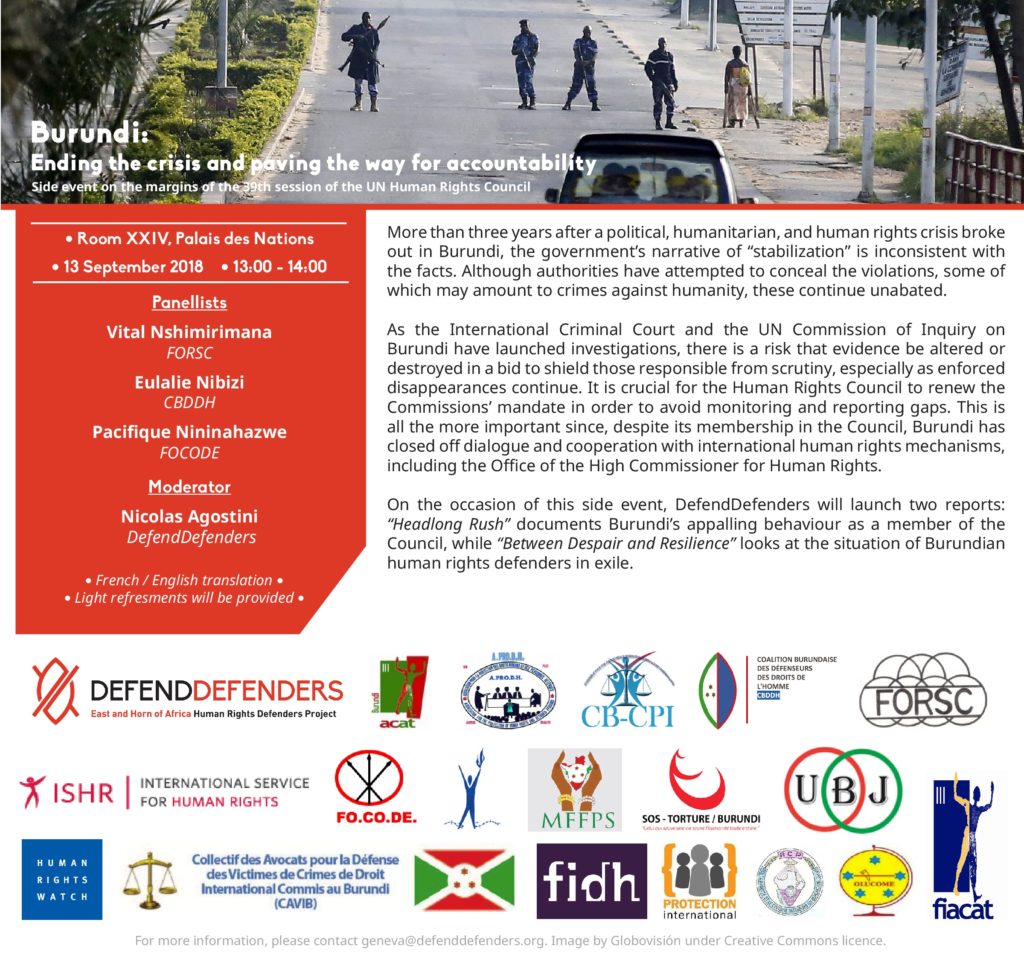
In a side event, our panellists highlighted the ongoing grave human rights situation in Burundi and called on states to support the extension of the CoI’s mandate so it can pursue its important investigating and evidence-gathering work. We officially launched two reports. Headlong Rush documents Burundi’s appalling behaviour as a member of the Council (2016-2018), while Between Despair and Resilience examines the situation of Burundian HRDs in exile. Once again, the only responses the Burundian government offered to the CoI’s report were denial and insults. It went as far as declaring the three members of the CoI personae non gratae on Burundi’s territory.
In a press release, we stressed the importance of the resolution adopted by the Council and the fact that Burundi’s obstructive behaviour is a futile attempt to prevent accountability.
Ethiopia has seen remarkable positive change since Abiy Ahmed took office as Prime Minister in April 2018. Now that the state of emergency has been lifted, thousands of political prisoners have been released, and authorities have signaled a willingness to review repressive laws, the country finds itself at a critical junction. Although the Prime Minister conceded security forces have committed violations during the mass protests that have rocked Ethiopia since November 2015, the perpetrators are yet to be brought to justice. During a side-event, DefendDefenders joined other panelists to look at the possible role of regional and international mechanisms to ensure accountability and that systemic human rights issues are addressed.
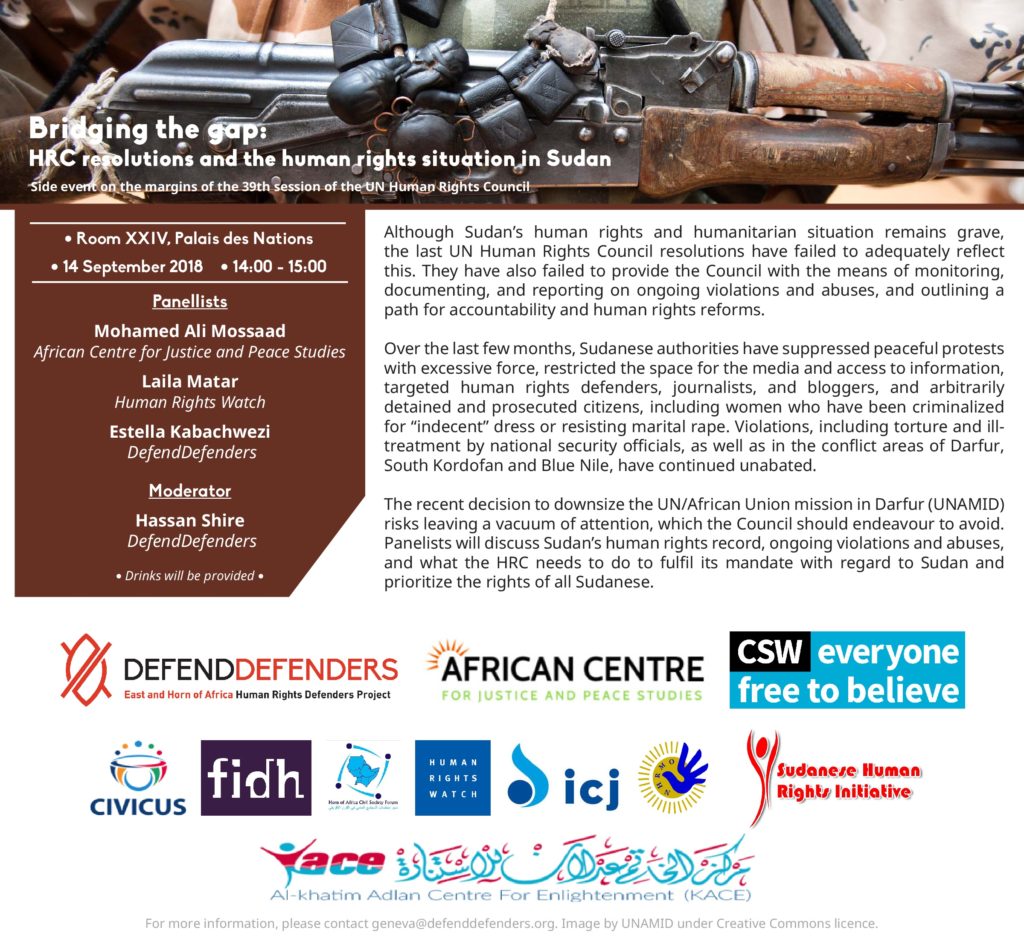
Looking at Sudan, year after year, resolutions on the country continue to be among the most difficult and frustrating to negotiate at the Council. In 2017, the Sudanese government managed to insert language on “transition” (paving its way out of the Independent Expert’s (IE) mandate) in the resolution addressing its domestic situation. This year, while the government did not succeed in formally inscribing its exit from the Council’s agenda in the resolution that was adopted, the latter remained weak and failed to reflect the situation on the ground. It provides for an end to the IE’s mandate on condition that an OHCHR office be operational in Khartoum. DefendDefenders maintains that the Council should consider Sudan under its agenda item 4, which is dedicated to the gravest situations of human rights violations, not item 10. We held a side event to highlight the gap between HRC resolutions on the country and the situation on the ground.
We continued to highlight the deteriorating human rights situation in Tanzania. Since President John Magufuli took office in October 2015, there has been increased concern about Tanzania’s crackdown on civic space, as authorities are growing intolerant of critical voices. Following a report we published in June 2018, and a letter we sent to states ahead of HRC39 suggesting concrete proposals for oral statements, we have seen increased attention to the country. During the general debate under item 2, the European Union thus raised concerns about restrictions to freedoms of expression and assembly, including “arrests of, and charges against, human rights defenders, journalists, bloggers and members of parliament.”
Regarding South Sudan, DefendDefenders welcomed the revitalised peace agreement, but stressed that peace should not come at the expense of accountability. We once again called on the South Sudanese government to sign the Memorandum of Understanding to formally establish and operationalise the Hybrid Court for South Sudan. The victims of crimes committed during the war deserve redress and accountability.
Ethiopia has seen remarkable positive change since Prime Minister Abiy Ahmed took office in April 2018. Building on the open letter Hassan Shire sent to Prime Minister Abiy, we encouraged further steps to address systemic and outstanding human rights issues, including the use of excessive and lethal force against protesters, and accountability for violations.
DefendDefenders also reacted to the last report of the Independent Expert on Somalia, taking stock of progress and calling on authorities to tackle ongoing issues including impunity, and published a press release for the adoption of the outcome of the Universal Periodic Review (UPR) of Djibouti, on 20 September 2018.
Lastly, as the next Human Rights Council election is scheduled for 12 October 2018 at the UN General Assembly in New York, DefendDefenders coordinated a civil society call on states to refrain from voting for candidates that are unfit for Council membership. We argue that “doing so will require leaving the ballot blank” for candidates that are unfit. These include Eritrea, which our UN Representative addressed in an opinion piece. This year’s election is made close-to-meaningless because of “clean slates” in all regional groups – the fact that all regional groups are running non-competitive slates, presenting the same number of candidates as there are seats available. The only competition that remains is between positive and blank votes. A state needs 97 positive votes to be elected to the Council; however, 97 blank votes would defeat a candidate. DefendDefenders calls on states to leave the ballot blank for Eritrea, which has demonstrated a record of grave human rights violations and non-cooperation with the UN human rights system, making a mockery of the Council’s membership standards.
Oral Statements to the Council
Mr. President, Madam High Commissioner,
DefendDefenders associates itself with the statement delivered by Human Rights Watch, and endorsed by over 750 organisations. We congratulate you on your appointment as High Commissioner and reiterate that the current climate highlights the need for a strong public advocacy role for your mandate in the defence of human rights and the international human rights system, as well as a strong role internally within the UN to mainstream respect for human rights.
We will address Burundi, Djibouti, South Sudan, Sudan, and Somalia under dedicated items. We are particularly worried about the negative steps Tanzania and Uganda have taken in recent months.
In Tanzania, while we welcome the granting of a license to Jamii Forums, we call on the government to cease any form of intimidation, harassment and attacks against human rights defenders, journalists, bloggers, and opposition members and their supporters, and amend laws and regulations to bring them into line with international human rights standards. We make particular reference to the Electronic and Postal Communications Act (2010) and Online Content Regulations (2018), the Statistics Act (2015), the Cybercrimes Act (2015), the Media Services Act (2016), and the Access to Information Act (2016).
In Uganda, we witnessed a dramatic crackdown on civic space as protests rocked the nation following the August 2018 Arua by-elections characterised by violence. Security forces responded to demonstrations with excessive force, killing three. Several journalists covering the events, and detainees have made allegations of torture.
Thank you for your attention.
Mr. President, Madam High Commissioner,
We thank you for your final note, which makes it clear that the Burundian government has demonstrated absolute bad faith in its relationships with independent human rights actors such as your Office and the experts it deployed with a view to implementing HRC resolution 36/2.
Quoting from the OHCHR note: “It should be recalled that the Government of Burundi is a member of the Human Rights Council and that it supported the adoption of resolution 36/2.” Recalling DefendDefenders’ statement last June, we stated that “Burundi denying access to—or even worse: withdrawing visas from—the experts mandated by a resolution the government has itself supported can only be referred to as what it is: a case of extreme policy incoherence.” At the time, the Burundian government still had a chance to re-establish cooperation with OHCHR and start acting on its pledges. It has not done so.
Mr. President,
DefendDefenders just published a report, “Headlong Rush,” which comprehensively documents Burundi’s appalling behaviour as a member of this Council. Its pattern of non-cooperation should have triggered action with regard to its membership rights. It has not, but we stress that leaving the Council should not lead the Burundian government to think that it will quietly be removed from the international community’s attention. With our partners, we will advocate for this Council, and other regional and international bodies and mechanisms, including the International Criminal Court, to define a path towards full accountability for the crimes committed, including those ordered by the highest political level.
Thank you for your attention.
Mr. President, Members of the Commission of Inquiry,
We thank you for your final report, which debunks the narrative propagated by the Burundian government – that of an “improvement” of the situation. The fact that you focused on violations of economic and social rights, and on the overall impoverishment of the country, is also welcome as it shows the multifaceted character of the crisis.
As so many Burundians have lost their lives or their loved ones, and so many of our colleagues, including Germain Rukuki, Emmanuel Nshimirimana, Aimé Constant Gatore, Marius Nizigama, and Nestor Nibitanga, are unjustly detained, and others, like Marie-Claudette Kwizera, have been disappeared, we ask: When is the Burundian government going to face the truth, change course, and cooperate?
Mr. President,
The Burundian government has rejected any form of cooperation with international mechanisms. It has refused to cooperate with the Commission of Inquiry. It has prevented the implementation of resolution 36/2, which was initiated by African countries including Burundi itself. It has withdrawn visas from the experts who had been mandated by that resolution. It has suspended its cooperation with OHCHR. It has just declared the three commissioners personae non gratae.
Bujumbura had already done the same with other international diplomats. Today, there is no other mechanism to investigate and document the violations that are being committed.
All these examples, and the behaviour of the Burundian government, justify the imperative need to renew the mandate of the Commission of Inquiry. We call on this Council to do so.
Thank you for your attention.
Monsieur le Président, chers membres de la Commission d’enquête,
Nous vous remercions pour votre rapport final, qui apporte un démenti circonstancié au récit propagé par le gouvernement burundais : celui d’une « amélioration » de la situation. Le fait que vous vous soyez concentrés sur les violations des droits économiques et sociaux et sur l’appauvrissement général du pays, montrant les multiples aspects de la crise, est également très important.
Alors que tant de Burundais ont perdu la vie ou leurs proches, et que tant de collègues, dont Germain Rukuki, Emmanuel Nshimirimana, Aimé Constant Gatore, Marius Nizigama, et Nestor Nibitanga, sont injustement détenus, et que d’autres, comme Marie-Claudette Kwizera, restent portés disparus, nous demandons : Quand le gouvernement burundais va-t-il reconnaître la vérité, changer de cap, et coopérer ?
Monsieur le Président,
Le gouvernement du Burundi a refusé toute coopération avec les mécanismes internationaux. Il a refusé de coopérer avec la Commission d’enquête. Il a bloqué la mise en œuvre de la résolution 36/2, initiée par les pays africains dont le Burundi lui-même. Il a retiré leurs visas aux experts mandatés par cette résolution. Il a suspendu sa coopération avec le HCDH. Il vient de déclarer personnes non désirées les trois commissaires. Bujumbura avait déjà fait de même avec d’autres diplomates internationaux. Il n’existe aucun autre mécanisme d’enquête et de documentation des violations qui sont en train d’être commises.
Tous ces exemples, et le comportement du gouvernement burundais, justifient l’impérieuse nécessité de renouveler le mandat de la Commission d’enquête. Nous appelons ce Conseil à le faire.
Je vous remercie de votre attention.
Mr. President,
The East and Horn of Africa Human Rights Defenders Project (DefendDefenders) thanks the
Commission on Human Rights in South Sudan for its oral update, and reiterates the call for justice and accountability following the signing of the revitalised peace agreement.
Although we welcome the sentencing of the military personnel convicted for rape and murder
during the July 2016 attack on the Terrain Hotel in Juba, the same justice should be extended to all victims of human rights violations committed during the five-year conflict in South Sudan. While peace and order are necessary elements for human rights to flourish, they should not come at the cost of accountability, which must be ensured in order to end the cycle of revenge and violence that has plagued the region for decades.
The South Sudanese government should sign the Memorandum of Understanding to formally establish and operationalise the Hybrid Court for South Sudan to ensure transparent accountability for crimes committed during the war.
The new peace deal represents hope for South Sudan to end a war that has claimed tens of
thousands of lives and dispersed many South Sudanese across East Africa, not to mention contributed to rampant sexual violence and food insecurity in the country.
We urge all the warring parties to respect the terms of this agreement, including the unilateral ceasefire, and work towards rebuilding the world’s youngest nation.
Thank you for your attention.
Mr. President,
DefendDefenders welcomes the proposed reforms by the Ethiopian government in favour of greater respect for Ethiopians’ fundamental rights and freedoms, accountability for past and ongoing human rights violations and abuses, security sector reform, and inclusive political
dialogue and reconciliation.
Its initial steps, namely the release of political prisoners, the closing of detention centres, the lifting of the State of Emergency, the replacement of high-level officials suspected of violations, reconciliation with Eritrea, and the establishment of a committee tasked with reviewing laws and the justice system, have sent a powerful signal to all Ethiopians that their rights matter.
To further advance the reform agenda, systemic human rights issues facing the country should be addressed. We encourage Ethiopia to look at all aspects of accountability, including sanctions, but also reparation in the form of apologies, compensation and/or rehabilitation; truth-telling;
reconciliation; guarantees of non-recurrence; security sector reform; vetting; and the provision of training to security and law enforcement officials. Grave crimes should not be the object of any amnesty.
Free and fair elections and an open civic space providing for a safe and enabling environment for human rights defenders, civil society, journalists and other independent voices are also of critical importance. The process of revision of the following laws should be fast-tracked in a transparent and inclusive manner: the Civil Society Proclamation; Regulation No. 168/2009; the mandate and powers of the Charities and Societies Agency; Proclamation No. 3 (1991) on peaceful assembly; and media-related laws, in particular provisions that enable censorship, restrict ownership of media houses and residency of media outlet owners, and criminalise defamation.
We welcome Ethiopia’s engagement with bilateral, regional, and international actors, including the Office of the UN High Commissioner for Human Rights (OHCHR), and look forward to further engaging with the authorities in order to explore cooperation and ways in which we and civil society partners can contribute to, and participate in, the consolidation of democracy, respect for human rights, and the rule of law in Ethiopia.
Thank you for your attention.
Mr. President,
DefendDefenders and the Djiboutian Observatory for the Promotion of Democracy and Human Rights (ODDH) took note of the Djiboutian government’s replies to the recommendations it recei- ved, including those pertaining to the ratification of international instruments or the acceptance of free and independent trade unions. We regret that Djibouti refused to commit to extending a stand- ing invitation to the Human Rights Council’s special procedures, given that the lack of an indepen- dent assessment of the country’s human rights situation is flagrant.
On 15 April 2018, two days after he came back from Geneva, where he participated in the UPR pre-sessions, Kadar Abdi Ibrahim was briefly detained and his passport was confiscated by agents of the Documentation and Security Service (SDS). He has been unable to leave the country since. As Djibouti accepted recommendations 129.97 and 129.202 on the fight against threats, harassment and intimidation and on the need to carry out investigations into such acts committed against hu- man rights defenders, we ask: When will his passport be given back to him?
Djibouti committed to preventing the use of excessive force against civilians by security forces, inc- luding during demonstrations and elections (recommendation 129.73). However, at the same time the government refused to “improve training programmes for security forces to put an end to acts of violent repression of peaceful demonstrations” (129.51). We fear that this inconsistence actually re- flects a lack of political will on the part of the government to implement its obligations.
Indeed, Djibouti accepted recommendation 129.95, which called on it to implement nine recom- mendations it accepted during the second cycle of the UPR. We salute the persistence of Zambia, which authored that recommendation, but its content had already been accepted back in 2013. It remained unimplemented. Will Djibouti appear before this Council every four and a half years to promise that it will act on recommendations it accepted in the previous cycle? Or will it, at last, de- liver on its commitments?
Thank you for your attention.
Monsieur le Président,
DefendDefenders et l’Observatoire djiboutien pour la promotion de la démocratie et des droits humains (ODDH) ont pris note des réponses du gouvernement djiboutien aux recommandations qu’il a reçues. Nous l’appelons à mettre en œuvre sans délai celles qu’il a acceptées, tenant notamment à la ratification d’instruments juridiques internationaux ou à l’acceptation de syndicats libres et indépendants. Nous regrettons que Djibouti ait refusé de s’engager à offrir une invitation ouverte et permanente aux procédures spéciales du Conseil des droits de l’homme, alors que le manque d’évaluation indépendante de la situation des droits humains dans le pays se fait cruellement sentir.
Le 15 avril 2018, deux jours après être rentré de Genève, où il avait participé aux pré-sessions de l’EPU, Kadar Abdi Ibrahim a été́ brièvement détenu et son passeport confisqué par des agents du Service de la documentation et de la sécurité (SDS). Il se trouve depuis dans l’impossibilité de quitter le pays. Djibouti ayant accepté les recommandations 129.97 et 129.202 sur la lutte contre les actes de menaces, de harcèlement et d’intimidation et la conduite d’enquêtes sur tout acte commis à l’encontre des défenseurs des droits humains, nous demandons au gouvernement : Quand son passeport lui sera-t-il rendu ?
Djibouti s’est engagé à prévenir l’usage excessif de la force contre des civils par les forces de sécurité, notamment lors de manifestations et d’élections (recommandation 129.73). Or, le gouvernement a dans le même temps refusé d’« améliorer les programmes de formation des forces de sécurité́ pour mettre fin aux actes de répression violente de manifestations pacifiques » (129.51). Nous craignons que cette incohérence ne traduise en fait un manque de volonté politique du gouvernement de mettre en œuvre ses obligations.
En effet, Djibouti a accepté la recommandation 129.95, l’appelant à mettre en œuvre neuf recommandations acceptées lors du deuxième cycle de l’EPU. Nous saluons la persistance de la Zambie, auteure de cette recommandation. Toutefois, son contenu avait déjà été accepté en 2013. Il est resté lettre morte. Djibouti va-t-il, tous les quatre ans et demi, se représenter devant ce Conseil en promettant d’appliquer les recommandations du cycle précédent ? Ou bien va-t-il enfin agir en conformité avec ses engagements ?
Je vous remercie de votre attention.
Mr. President, Mr. Independent Expert,
DefendDefenders thanks you for your report, which reflects positive developments, challenges and issues, including terrorist attacks by militant group Al-Shabaab.
The establishment and process of staffing of the National Human Rights Commission is an important step towards greater respect for the rights of all Somali citizens. We encourage the swift operationalisation of the Commission, including through the provision of adequate funding for its work.
We commend the launch of the Joint Human Rights Programme, as well as the steps towards human rights compliance that AMISOM has taken, including the adoption of standard operating procedures and guidelines on the use of fire and handling of detainees. The launch of a constitutional review process and the passage of an electoral law are also important steps towards “one-person, one-vote” elections in 2020.
We remain concerned over violations of freedom of expression, women’s rights and children’s rights, including the rights of minors recaptured from Al-Shabaab. Sexual and gender-based violence and the practice of female genital mutilation continue to be committed with widespread impunity. The adoption of the Sexual Offences Bill is a step in the right direction, but much more will need to be done to bring about structural and societal change.
We deplore acts of intimidation, harassment, and attacks against journalists, which remain pervasive throughout the country, and punishment of those who express dissent. For instance, in the self-declared Republic of Somaliland, poet and peace activist Naema Qorane was sentenced to three years in jail on charges of “anti-national activity of a citizen and bringing the nation or state in contempt.” She was later pardoned.
In August 2018, DefendDefenders designated Mohamed Farah, a Somali human rights defender and founder of the Somali Disability Empowerment Network (SODEN), Defender of the Month. Farah’s advocacy for people with disabilities, and against the serious discrimination they face, is a ray of hope in a country that has long overlooked the challenges faced by vulnerable and disadvantaged groups. We therefore applaud the announcement, made last week following a Council of Ministers meeting, that Somalia will ratify the Convention on the Rights of Persons with Disabilities.
Thank you for your attention.
Mr. President, Mr. Independent Expert,
DefendDefenders thanks you for your report. We are struck by your assessment, contained in paragraph 73, that in spite of assurances from the Sudanese authorities to take steps towards implementing the recommendations contained in your previous reports, – I quote – “a significant number of these recommendations have still not been implemented.”
Throughout the years, Sudan has failed to cooperate in good faith with your mandate and with other human rights mechanisms. The government has:
– Denied experts access to certain areas, in particular conflict areas, and prevented them from meeting with independent actors free from surveillance;
– Attempted to monitor meetings between experts and civil society;
– Attacked you and your predecessors whenever you raised patterns of human rights violations (with claims that the mandate had been “overstepped”);
– Denied the fact that monitoring and public reporting are the basis of technical assistance – there can be no advice without knowledge;
– Prevented meaningful, inclusive and transparent discussion of resolutions; and
– Engaged in intimidation and reprisals against representatives of civil society, including human rights defenders who attempted to travel to Geneva to attend the “UPR pre-sessions” in 2016 – despite the fact that Sudan officially praises the UPR.
In a nutshell, what Sudan needs is not more technical assistance, but political will to improve the situation.
Item 10 is often the object of misperceptions. NGOs like DefendDefenders do believe that it is a useful tool and that it should be used with states that truly need advice and capacity-building. But item 10 should not be abused. Governments that demonstrate a pattern of bad faith should not be allowed to abuse the Council’s time and resources.
Thank you for your attention.
Briefing papers and press releases
To Permanent Representatives of Member and Observer States of the United Nations Human Rights Council, Geneva, Switzerland
Burundi: Call to renew the mandate of the Commission of Inquiry
Excellencies,
Ahead of the 39th session of the UN Human Rights Council (“HRC” or “the Council”), we, the undersigned national, regional and international civil society organisations, write to urge your delegation to support a resolution renewing the mandate of the UN Commission of Inquiry (CoI) on Burundi.[1] Such a resolution should also ensure continuity for the work of the CoI through continued adequate resourcing of its secretariat, including its crucial investigative and evidence-gathering work.
The renewal of the CoI’s mandate is critically important to improve the human rights situation in Burundi, and it offers the Council a number of practical and effective advantages. Among other things, it would allow the Council to:
- Avoid a monitoring gap, which is all the more important given the Burundian Government’s ongoing refusal to cooperate with the Office of the UN High Commissioner for Human Rights (OHCHR) and to sign a new Memorandum of Understanding regarding its presence in the country;[2]
- Ensure the continued documentation of human rights violations and abuses ahead of the upcoming elections of 2020, through testimonies of victims, witnesses, human rights defenders, and other actors operating in and outside of the country;
- Ensure ongoing public reporting and debates — while the African Union’s observers continue to monitor the human rights situation in Burundi despite a number of limitations imposed by the authorities, their findings are not publicly reported. Interactive dialogues at the Council provide the only regular space for public reporting and debates on human rights developments in the country; and
- Enable the CoI to continue to highlight under-addressed aspects of the crisis — for instance, the Commission has stressed the importance of dedicating more attention to violations of economic, social and cultural rights.
At the Council’s 36th session (September 2017), the CoI informed the HRC that there were “reasonable grounds to believe that serious human rights violations and abuses have been committed in Burundi since 2015,” and that some of the violations may constitute “crimes against humanity.” At the 37th and 38th sessions of the Council (March and June-July 2018), the CoI described a political, security, economic, social and human rights situation that has not improved since September 2016. In March 2018, the Commission’s Chairperson, Mr. Doudou Diène, stressed that the situation in the country continued to deserve the Council’s “utmost attention.” In October 2017, the International Criminal Court (ICC) authorised an investigation into crimes committed in Burundi since April 2015. A preliminary examination of the situation had been opened in April 2016.
The constitutional referendum that was held on 17 May 2018 was marred with violence and repression, with arbitrary arrests, beatings and intimidation of citizens campaigning for a “no” vote.[3] The BBC and VOA, two of the country’s main international radio stations, have been suspended for 6 months at the start of the official campaign, illustrating the climate of fear in which journalists and medias were prevented from a proper coverage of the event.[4] In the Commission’s words, as of June 2018 “human rights violations, among which extrajudicial executions, enforced disappearances, acts of torture and other cruel, inhuman or degrading treatment […], facilitated by a continuing environment of threats and intimidation,” continue unabated. The CoI added: “The fact that several missing people have not been found and that unidentified bodies continue to be discovered in various parts of the country gives reason to fear the continuation of practices consisting of getting rid of the bodies of people arrested sometimes by individuals in police uniform or identified as agents of the National Intelligence Service (SNR) or the Imbonerakure.”[5]
Since it became a member of the Council, on 1 January 2016, Burundi has delivered multiple statements that have made clear its refusal to cooperate with human rights monitoring and investigation bodies and mechanisms. The Government has repeatedly launched attacks, which have sometimes descended to a personal level, against the High Commissioner, UN officials, and independent experts. With no basis or evidence, it has publicly questioned the independence, competence, professionalism, integrity and legitimacy of High Commissioner Zeid and his Office, and has threatened, stigmatised, and exercised reprisals against human rights defenders and civil society organisations.[6] Burundians who have sought protection outside of Burundi have been subjected to harassment and persecution, including by members of the National Intelligence Service (SNR) and Imbonerakure.
Members of the CoI continue to be denied access to Burundi. Furthermore, at the time of writing, the Burundian authorities have withdrawn visas from the team of experts mandated by HRC resolution 36/2, despite the fact that the latter was adopted at Burundi’s own initiative, with its support and the support of members of Burundi’s own regional group. Burundi’s action in this regard clearly violates its Council membership obligations.
Recalling the letter a group of civil society organisations wrote in September 2017,[7] we urge the Council, consistent with its mandate to address situations of violations of human rights, including gross and systematic violations, to pave the way for accountability by renewing the mandate of the CoI to enable it to continue monitoring human rights developments in the country, documenting violations and abuses, and publicly reporting on the situation.
We thank you for your attention to these pressing issues and stand ready to provide your delegation with further information as required.
Sincerely,
- Action des Chrétiens pour l’Abolition de la Torture – Burundi (ACAT-Burundi)
- African Centre for Justice and Peace Studies (ACJPS)
- Amnesty International
- Association Burundaise pour la Protection des Droits Humains et des Personnes Détenues (APRODH)
- Association for Human Rights in Ethiopia (AHRE)
- Centre for Civil and Political Rights (CCPR)
- CIVICUS: World Alliance for Citizen Participation
- Coalition Burundaise pour la Cour Pénale Internationale (CB-CPI)
- Collectif des Avocats pour la Défense des Victimes de Crimes de Droit International Commis au Burundi (CAVIB)
- Community Empowerment for Progress Organisation South Sudan (CEPO)
- DefendDefenders (the East and Horn of Africa Human Rights Defenders Project)
- East and Horn of Africa Human Rights Defenders Network (EHAHRD-N)
- Eritrean Law Society (ELS)
- Eritrean Movement for Democracy and Human Rights (EMDHR)
- Forum pour la Conscience et le Développement (FOCODE)
- Forum pour le Renforcement de la Société Civile au Burundi (FORSC)
- Global Centre for the Responsibility to Protect (GCR2P)
- Human Rights Concern – Eritrea
- Human Rights Watch
- International Federation for Human Rights (FIDH)
- International Federation of Action by Christians for the Abolition of Torture (FIACAT)
- International Movement Against All Forms of Discrimination and Racism (IMADR)
- International Service for Human Rights (ISHR)
- Ligue Iteka
- Mouvement Citoyen pour l’Avenir du Burundi (MCA)
- Mouvement des Femmes et des Filles pour la Paix et la Sécurité (MFFPS)
- National Coalition of Human Rights Defenders – Burundi (CBDDH)
- Observatoire de la Lutte contre la Corruption et les Malversations Économiques (OLUCOME)
- Organisation pour la Transparence et la Gouvernance (OTRAG)
- Pan-African Human Rights Defenders Network
- Reporters Without Borders (RSF)
- Réseau des Citoyens Probes (RCP)
- SOS-Torture/Burundi
- TRIAL International
- Union Burundaise des Journalistes (UBJ)
- World Organisation Against Torture (OMCT)
[1] See its webpage: www.ohchr.org/EN/HRBodies/HRC/CoIBurundi/Pages/CoIBurundi.aspx
[2] See the UN Deputy High Commissioner for Human Rights’ statement at the Council’s 37th session (OHCHR, “Introduction to country reports/briefings/updates of the Secretary-General and the High Commissioner under item 2,” 21-22 March 2018, www.ohchr.org/EN/NewsEvents/Pages/DisplayNews.aspx?NewsID=22875&LangID=E, accessed 20 July 2018).
[3] FIDH and Ligue Iteka, “A forced march to a Constitutional Referendum,” May 2018, www.fidh.org/IMG/pdf/report_burundi_may2018_referendum_on_constitution.pdf(accessed 27 July 2018).
[4] Reporters Without Borders, “Harassment of Burundi’s media intensifies for referendum,” 16 May 2018, www.rsf.org/en/news/harassment-burundis-media-intensifies-referendum# (accessed 7 August 2018).
[5] OHCHR, “Oral briefing by the members of the Commission of Inquiry on Burundi to the Human Rights Council,” 27 June 2018, www.ohchr.org/EN/NewsEvents/Pages/DisplayNews.aspx?NewsID=23274&LangID=E(accessed 20 July 2018).
[6] See DefendDefenders, “Headlong Rush: Burundi’s behaviour as a member of the UN Human Rights Council,” 25 July 2018, www.defenddefenders.org/publication/headlong-rush-burundis-behaviour-as-a-member-of-the-un-human-rights-council/ (accessed 25 July 2018).
[7] “Renewing the Mandate of the Commission of Inquiry on Burundi and Ensuring Accountability for Serious Crimes,” 19 September 2017, www.defenddefenders.org/press_release/hrc36-renewing-the-mandate-of-the-commission-of-inquiry-on-burundi-and-ensuring-accountability-for-serious-crimes/(accessed 30 July 2018).
À l’attention des Représentants permanents des États Membres et Observateurs du Conseil des droits de l’homme de l’ONU, Genève (Suisse)
Burundi : Appel au renouvellement du mandat de la Commission d’enquête
Madame, Monsieur la(le) Représentant(e) permanent(e),
En amont de la 39ème session du Conseil des droits de l’homme de l’ONU (« CDH » ou « Conseil »), nous soussignées, des organisations nationales, régionales et internationales de la société civile, vous écrivons afin d’exhorter votre délégation à soutenir une résolution renouvelant le mandat de la Commission d’enquête (CoI) des Nations Unies sur le Burundi[1]. Une telle résolution devrait également assurer une continuité au travail de la CoI par le biais d’un financement adéquat continu de son secrétariat, y compris son travail crucial d’enquête et de rassemblement de preuves.
Le renouvellement du mandat de la CoI est d’une importance capitale pour améliorer la situation des droits humains au Burundi. Il offrirait un certain nombre d’avantages pratiques et concrets. Entre autres, il permettrait au Conseil :
- D’éviter un vide en termes de surveillance de la situation (« monitoring»), ce qui est d’autant plus important que le Gouvernement burundais continue de refuser de coopérer avec le Bureau du Haut-Commissaire des Nations Unies aux droits de l’homme (HCDH) et de signer un nouveau Mémorandum d’accord concernant la présence de ce dernier dans le pays[2] ;
- De rendre possible une documentation continue des violations et des atteintes aux droits humains en amont des élections de 2020, via des témoignages de victimes, de témoins, de défenseurs des droits humains et d’autres acteurs opérant dans le pays et à l’extérieur ;
- De s’assurer que des rapports continuent à être présentés publiquement et que des débats ont lieu — alors que les observateurs de l’Union africaine poursuivent leur travail de surveillance de la situation au Burundi en dépit d’un certain nombre de restrictions imposées par les autorités, leurs conclusions ne sont pas rendues publiques. Les dialogues interactifs se tenant pendant les sessions du Conseil fournissent le seul espace régulier de discussion publique des développements en matière de droits humains dans le pays ; et
- De permettre à la CoI de continuer à faire la lumière sur certains aspects sous-documentés de la crise — par exemple, la Commission a signalé l’importance de dédier une attention plus importante aux violations des droits économiques, sociaux et culturels.
Pendant la 36ème session du Conseil (septembre 2017), la CoI a informé le CDH qu’elle avait des « motifs raisonnables de croire que de graves violations et atteintes aux droits de l’homme avaient été commises au Burundi depuis 2015 » et que certaines de ces violations pourraient être constitutives de « crimes contre l’humanité́ ». Lors des 37ème et 38ème sessions du Conseil (mars et juin-juillet 2018), la CoI a décrit une situation politique, sécuritaire, économique, sociale et en termes de droits humains qui ne s’est pas améliorée depuis septembre 2016. En mars 2018, le président de la Commission, M. Doudou Diène, a souligné que la situation du pays continuait de requérir l’attention « urgente » du Conseil. En octobre 2017, la Cour pénale internationale (CPI) autorisait l’ouverture d’une enquête sur les crimes commis au Burundi depuis avril 2015. Un examen préliminaire de la situation avait été́ ouvert en avril 2016.
Le référendum constitutionnel qui s’est tenu le 17 mai 2018 a été marqué par les violences et la répression, avec notamment des arrestations arbitraires, des tabassages et des actes d’intimidation des citoyens faisant campagne pour le « non »[3]. La BBC et VOA, deux des principales radios internationales, ont été suspendues pour six moins dès le début de la campagne référendaire qui s’est déroulée dans un climat de peur généralisée, empêchant les journalistes d’exercer librement leur mission d’information.[4] Selon la Commission, en juin 2018, des « violations des droits de l’homme, parmi lesquelles des exécutions extrajudiciaires, des disparitions forcées, des actes de torture et autres mauvais traitements cruels, inhumains ou dégradants […], favorisées par un climat continu de menaces et d’intimidations », continuent à être commises sans relâche. La CoI a ajouté : « Le fait que plusieurs personnes disparues n’aient pas été retrouvées et que des corps non identifiés continuent d’être découverts dans divers endroits du pays font craindre la persistance de pratiques consistant à se débarrasser des corps des personnes parfois arrêtées par des individus en uniforme de la police ou identifiés comme étant des agents du Service national de renseignement (SNR) ou des Imbonerakure »[5].
Depuis qu’il est devenu membre du Conseil, le 1er janvier 2016, le Burundi a à de multiples reprises lu des déclarations indiquant clairement son refus de coopérer. Le Gouvernement a régulièrement lancé des attaques, descendant parfois à un niveau personnel, contre le Haut-Commissaire, des représentants de l’ONU et des experts indépendants. Il a publiquement et sans aucune base mis en cause l’indépendance, la compétence, le professionnalisme, l’intégrité et la légitimité du Haut-Commissaire Zeid et de son Bureau, et il a menacé et stigmatisé des défenseurs des droits humains et des organisations de la société civile, et s’est livré à des représailles à leur encontre[6]. Un certain nombre de Burundais ayant cherché protection et refuge à l’étranger ont été soumis à des actes de harcèlement et de persécution, notamment par des membres du Service national de renseignement (SNR) et des Imbonerakure.
Les membres de la CoI continuent de se voir refuser l’accès au Burundi. En outre, au moment où cette lettre est écrite, les autorités burundaises ont retiré leurs visas à l’équipe d’experts mandatée par la résolution 36/2 du CDH, en dépit du fait que celle-ci a été adoptée à l’initiative du Burundi et avec son soutien et celui de membres de son groupe régional. Le comportement du Burundi à cet égard est clairement en violation de ses obligations de membre du Conseil.
Tout en rappelant la lettre qu’un groupe d’organisations de la société civile a écrite en septembre 2017[7], nous exhortons le Conseil, conformément au mandat qui lui a été conféré de répondre aux violations des droits de l’homme, notamment lorsque celles-ci sont flagrantes et systématiques, à préparer le terrain à la reddition de comptes en renouvelant le mandat de la CoI afin de lui permettre de continuer à suivre les développements dans le pays, à rassembler des informations sur les violations et atteintes commises et à faire rapport de façon publique sur la situation.
Nous vous remercions de l’attention que vous porterez à ces préoccupations et nous tenons prêts à fournir à votre délégation toute information supplémentaire dont vous auriez besoin. Nous vous prions de croire, Madame, Monsieur, en l’assurance de notre respectueuse considération.
- Action des chrétiens pour l’abolition de la torture – Burundi (ACAT-Burundi)
- African Centre for Justice and Peace Studies (ACJPS)
- Amnesty International
- Association burundaise pour la protection des droits humains et des personnes détenues (APRODH)
- Association pour les droits humains en Éthiopie (AHRE)
- Centre pour les droits civils et politiques (CCPR)
- CIVICUS : World Alliance for Citizen Participation
- Coalition burundaise pour la Cour pénale internationale (CB-CPI)
- Coalition burundaise des défenseurs des droits de l’homme (CBDDH)
- Collectif des avocats pour la défense des victimes de crimes de droit international commis au Burundi (CAVIB)
- Community Empowerment for Progress Organisation (Soudan du Sud) (CEPO)
- DefendDefenders (le Projet des défenseurs des droits humains de l’Est et de la Corne de l’Afrique)
- Eritrean Law Society (ELS)
- Fédération internationale des droits de l’Homme (FIDH)
- Fédération internationale de l’Action des chrétiens pour l’abolition de la torture (FIACAT)
- Forum pour la conscience et le développement (FOCODE)
- Forum pour le renforcement de la société civile au Burundi (FORSC)
- Global Centre for the Responsibility to Protect (GCR2P)
- Human Rights Concern – Eritrea
- Human Rights Watch
- Ligue Iteka
- Mouvement citoyen pour l’avenir du Burundi (MCA)
- Mouvement érythréen pour la démocratie et les droits humains (EMDHR)
- Mouvement des femmes et des filles pour la paix et la sécurité (MFFPS)
- Mouvement international contre toutes les formes de discrimination et de racisme (IMADR)
- Observatoire de la lutte contre la corruption et les malversations économiques (OLUCOME)
- Organisation mondiale contre la torture (OMCT)
- Organisation pour la transparence et la gouvernance (OTRAG)
- Reporters Sans Frontières (RSF)
- Réseau des citoyens probes (RCP)
- Réseau des défenseurs des droits humains de l’Est et de la Corne de l’Afrique (EHAHRD-N)
- Réseau panafricain des défenseurs des droits de l’homme
- Service international pour les droits de l’Homme (SIDH)
- SOS-Torture/Burundi
- TRIAL International
- Union burundaise des journalistes (UBJ)
[1] Voir le site Internet de la CoI : www.ohchr.org/EN/HRBodies/HRC/CoIBurundi/Pages/CoIBurundi.aspx
[2] Voir le discours de la Haute-Commissaire adjointe des Nations Unies aux droits de l’homme lors de la 37ème session du Conseil (HCDH, « Introduction to country reports/briefings/updates of the Secretary-General and the High Commissioner under item 2 », 21-22 mars 2018, www.ohchr.org/EN/NewsEvents/Pages/DisplayNews.aspx?NewsID=22875&LangID=E (consulté le 20 juillet 2018).
[3] FIDH et Ligue Iteka, « Référendum constitutionnel à marche forcée au Burundi », mai 2018, www.fidh.org/fr/regions/afrique/burundi/burundi-une-reforme-constitutionnelle-repressive-pour-concentrer-les (consulté le 27 juillet 2018).
[4] Reporters Sans Frontières, « Burundi : les journalistes sous haute pression pour le référendum constitutionnel », rsf.org/fr/actualites/burundi-les-journalistes-sous-haute-pression-pour-le-referendum-constitutionnel, 16 mai 2018 (consulté le 7 août 2018).
[5] HCDH, « Présentation orale de la Commission d’enquête sur le Burundi au Conseil des droits de l’homme », 27 juin 2018, www.ohchr.org/EN/NewsEvents/Pages/DisplayNews.aspx?NewsID=23274&LangID=F(consulté le 20 juillet 2018).
[6] Voir DefendDefenders, « Fuite en avant : Le comportement du Burundi en tant que membre du Conseil des droits de l’Homme de l’ONU », 25 juillet 2018, www.defenddefenders.org/publication/headlong-rush-burundis-behaviour-as-a-member-of-the-un-human-rights-council/#French (consulté le 25 juillet 2018).
[7] “Renewing the Mandate of the Commission of Inquiry on Burundi and Ensuring Accountability for Serious Crimes,” 19 septembre 2017, www.defenddefenders.org/press_release/hrc36-renewing-the-mandate-of-the-commission-of-inquiry-on-burundi-and-ensuring-accountability-for-serious-crimes/(consulté le 20 juillet 2018).
To Permanent Representatives of Member and Observer States of the UN Human Rights Council
Geneva, Switzerland
4 September 2018
Re: Addressing the serious human rights and humanitarian situation in Sudan
Excellencies,
We write to you in advance of the 39th Session of the United Nations Human Rights Council to share our serious concerns over the human rights and humanitarian situation in Sudan. We call upon your delegation to support the development and adoption of a strong monitoring and reporting mandate on Sudan under the Council’s agenda item 4. The resolution should mandate a Special Rapporteur to monitor, verify and report on ongoing human rights violations and abuses as well as violations of international humanitarian law, recommend concrete ways to end them, and urge the Government of Sudan to implement the recommendations made to it by UN human rights bodies and mechanisms, including mechanisms mandated by the Council.
Our organizations are concerned about the suppression of peaceful protests by government security forces with unlawful use of excessive force, attacks on the media and impermissible restrictions on access to information, targeting of various civil society actors including human rights defenders, activists, journalists, bloggers and other dissenting voices with threats, intimidation, harassment, arbitrary detention and trumped-up criminal prosecutions, other restrictions on independent civil society, use of torture and other ill-treatment by national security officials, and on-going violations in the conflict areas of Darfur, South Kordofan and Blue Nile.
The recent decision to downsize UNAMID amidst continuing fighting and attacks on civilians, including internally displaced persons (IDPs)[1] is deeply troubling. Recent attacks on civilians underscore the need for continued monitoring of the human rights situation in Darfur.[2] For example, from 9 March – 2 April 2018, at least 23 civilians were killed and tens seriously injured when 12 villages were burnt to the ground during attacks in Eastern Jebel Marra between the government forces and the Sudan Liberation Movement led by Abdelwahid al Nur (SLA-AW).[3] Sexual violence continues with impunity.[4] On 19 December 2017, a 16 year old girl and a 19 year old woman were held at gunpoint and raped repeatedly by six armed militiamen as they were out gathering firewood three kilometres from the internally displaced persons (IDPs) camp in Nertiti town, Central Darfur state.[5]
Following declaration of ceasefires by the Government of Sudan and the two factions of the Sudan People’s Liberation Movement /Army– North ( SPLM/A-N) led by Abdelaziz Adam El Hilu and Malik Agar, the government has largely refrained from aerial bombardments and ground attacks. Whilst there have been no reports of open hostilities between the armed forces, monitors on the ground have reported incidents of looting of property and abductions by armed militias allied to the Government of Sudan. These incidents, which may amount to ceasefire violations, have contributed to food insecurity and remain a serious concern for communities in South Kordofan and Blue Nile.[6]
Sudanese authorities have also continued to restrict basic freedoms of assembly and association through violent crackdowns on peaceful protesters and other restrictions on civil society organizations and on independent voices. Authorities have harassed journalists, human rights defenders and opposition party members, including through arbitrary and prolonged detention, sometimes in unknown locations, without charge and access to their families and lawyers.[7] On 29 May 2018, Mr. Hisham Ali Mohamad Ali, a human rights activist, was detained by the NISS upon arrival at the Khartoum International Airport following his deportation from Saudi Arabia. Mr. Hisham is still in detention without charge.[8] Authorities have continued to subject detainees to torture and other ill-treatment in custody,[9] causing the death of two individuals in two instances in March and April 2018.[10]
The Government of Sudan has also imposed restrictions on the movement of activists engaging in advocacy internationally. In August 2018, two members of the Darfur Bar Association were briefly detained and their passports confiscated in the Khartoum airport upon their return to Sudan after they accompanied the Secretary General of the DBA, Abdelrahman Elgasim, to the US to accept an award from the American Lawyers’ Association for his work on behalf of human rights in Darfur.
Restrictions on the media continue, especially during protests.[11] The national security agency has continued to apply post-print censorship to daily newspapers and prohibit chief editors from publishing on issues deemed controversial or critical of the ruling party.[12]
Sudanese authorities also routinely repress the human rights of women, including through public order provisions that criminalize “indecent” dress such as wearing trousers. Ms. Winnie Omer, a women’s rights activists based in Khartoum was first targeted on 10 December 2017, when the public order police in Khartoum arrested and charged her with “indecent dress” a few hours after she attended a hearing of 24 women charged with indecency for wearing pants during a private women-only party.[13]
Authorities have also relied on other repressive laws and various forms of harassment, including sexual harassment, to target activists. On 20 February 2018, Ms. Omer and three friends were arrested and detained for five days before being released on bail. The group was accused of, amongst other charges, prostitution, and Ms Omer and another female human rights defender were threatened with “virginity testing”.
On 24 July 2018, eight additional charges including crimes against the state were added to their case files. There has been no explanation as to the basis for the charges; however the trumped-up charges appear to be motivated by Omer’s activism.[14]
Authorities charged and sentenced to death 19 year old Noura Hussien for the murder of her husband in self-defense after he attempted to rape her for the second time alongside three other men.[15] The case raised serious concerns about Sudan’s imposition of the death penalty and its gender discriminatory laws that allow forced and early marriage, marital rape and weak victim protection measures, placing victims at risk of prosecution.[16] The death sentence was later reversed and Ms. Hussein re-sentenced to five years imprisonment and the payment of dia (blood money) to her husband’s family.
Freedom of religion or belief continues to be restricted in Sudan. On 11 February 2018, authorities demolished a Sudanese Evangelical Presbyterian Church (SEPC) in El Haj Yousif, Khartoum North, without notice.[17] The SPEC was one of 27 churches earmarked for demolition in an official order signed in June 2016. In July 2017, the Ministry of Education of Khartoum State issued an order requiring Christian schools in Khartoum state to operate on Sundays and take Friday and Saturday as their weekend, restricting their ability to observe religious ceremonies on Sundays. [18]
Given the downsizing of UNAMID, and the continuing violations across the country, it is imperative that the UN Human Rights Council take stronger action to ensure continued attention to the human rights situation in Sudan. Resolutions adopted by the Council since it decided to move consideration of Sudan from its agenda item 4 to item 10 have failed to adequately reflect the situation on the ground and outline a meaningful path for accountability and human rights reforms. At its 39th session, the Council should adopt a resolution under agenda item 4 to:
- Strengthen the special procedure mandate on Sudan by extending it as a Special Rapporteur on the situation of human rights in Sudan under item 4, with a mandate to monitor, verify, and publicly and periodically report on violations and abuses of human rights and violations of international humanitarian law in all parts of Sudan;
- Publically urge the Government of Sudan to implement the recommendations made to Sudan by UN human rights bodies and mechanisms, including mechanisms mandated by the Council and the 2016 Universal Periodic Review and to provide a mid-term report to the Council on concrete measures taken to implement the recommendations made to it during its UPR that enjoy its support, and the recommendations made by the Independent Expert during his 2017 report;
- Condemn attacks targeting the civilian population and civilian objects in Darfur, South Kordofan, and Blue Nile, in particular looting, destruction of civilian facilities, killings and sexual violence committed by paramilitary forces and other Sudanese government forces, which has led to forced displacement of civilian populations;
- Urge the government of Sudan to allow unfettered access by UNAMID, humanitarian agencies and concerned NGOs to all parts of Darfur, South Kordofan and Blue Nile;
- Urge the Government to ensure accountability for excessive use of force against protesters, which caused civilian deaths during crackdowns including in 2018 in El Geneina, West Darfur and Zalingei, Central Darfur; in 2016 in El Obeid, North Kordofan and Khartoum; in 2013 in Khartoum and Wad Medani; and in 2012 in Nyala, South Darfur and Al Jazeera.
- Condemn the continued restrictions on the media, on human rights defenders and political opponents, freedoms of association and of peaceful assembly, and the use of arbitrary detention and torture, as detailed;
- Condemn the ongoing violations of freedom of religion and repression of individuals based on their faith;
- Call for the release of all those arbitrarily detained by the NISS and urge the Government of Sudan to repeal the repressive National Security Act of 2010, and all other legislation which grants immunities to Government of Sudan agents and protection from criminal prosecution.
We thank you for your attention to these pressing issues.
Sincerely,
- Act for Sudan
- African Centre for Justice and Peace Studies
- African Freedom Coalition
- African Soul, American Heart
- Alkarama Foundation
- Al-Khatim Adlan Centre for Enlightenment and Human Development (KACE)
- Amnesty International
- Arab Coalition for Sudan
- Brooklyn Coalition for Darfur & Marginalized Sudan
- Christian Solidarity Worldwide
- Darfur Action Group of South Carolina
- Darfur and Beyond
- Darfur Community Center of Maine, USA
- DefendDefenders
- Genocide No More — Save Darfur
- Horn of Africa Civil Society Forum
- Human Rights Watch
- International Federation for Human Rights Leagues (FIDH)
- Investors Against Genocide
- Massachusetts Coalition for Darfur
- National Human Rights Monitoring Organisation
- Never Again Coalition
- Nuba Mountains Advocacy Group
- Nubia Project
- NY Coalition for Sudan
- Stop Genocide
- Sudan Democracy First Group
- Sudanese Human Rights Initiative
- Sudan Social Development Organisation (SUDO) UK
- The MagkaSama Project, France
- The Society for Threatened Peoples
[1] ACJPS, Attacks by Sudanese government forces on civilians in Jebel Marra in South Darfur, 18 April 2018, available at: http://www.acjps.org/attacks-by-sudanese-government-forces-on-civilians-in-jebel-marra-in-south-darfur/
[2] Human Rights Watch, Sudan: UN’s Planned Cuts to Darfur Mission Risk Rights Protection, 18 June 2018, available at: https://www.hrw.org/news/2018/06/18/sudan-uns-planned-cuts-darfur-mission-risk-rights-protection
[3] Ibid
[4] UN Special Representative of the Secretary-General on Sexual Violence in Conflict Ms. Pramila Patten Concludes Visit to Sudan and Calls for End to Culture of Denial for Conflict-Related Sexual Violence, 27 February 2018, available at: https://www.un.org/sexualviolenceinconflict/press-release/special-representative-of-the-secretary-general-on-sexual-violence-in-conflict-ms-pramila-patten-concludes-visit-to-sudan-and-calls-for-end-to-culture-of-denial-for-conflict-related-sexual-violence/
[5] ACJPS, Government allied militia gang rape a 16-year-old girl and a woman in Nertiti, Central Darfur state, 19 December 2017, available at: http://www.acjps.org/government-allied-militia-gang-rape-of-16-year-old-girl-and-a-woman-in-nertiti-central-darfur-state/
[6] NHRMO, Human Rights Update: September 2017 – February 2018, available at: http://www.sudanconsortium.org/member_publications/2018/HRUpdate092017to022018.pdf
[7] HRW, Don’t Be Taken in By Sudan Prisoner Release, 10 April 2018, available at: https://www.hrw.org/news/2018/04/10/dont-be-taken-sudan-prisoner-release; ACJPS, Sudan should charge or release remaining 248 individuals in prolonged detention, 16 April 2018, available at: http://www.acjps.org/sudan-should-charge-or-release-remaining-248-individuals-in-prolonged-detention/
[8] Amnesty International, Sudan: Human rights activist arbitrarily detained and at risk of torture must be immediately released, 31 May 2018, available at: https://www.amnesty.org/en/latest/news/2018/05/sudan-human-rights-activist-arbitrarily-detained-and-at-risk-of-torture-must-be-immediately-released/
[9] ACJPS, Two students reportedly tortured in West Kordofan state, 6 December 2017, available at: http://www.acjps.org/two-students-reportedly-tortured-in-west-kordofan-state/
[10] ACJPS, Urgent call for investigation into the custodial death of civilian whilst under SAF/RSF detention in East Jebel Marra, South Darfur, 24 April 2018, available at: http://www.acjps.org/urgent-call-for-investigation-into-the-custodial-death-of-civilian-whilst-under-safrsf-detention-in-east-jebel-marra-south-darfur-2/; ACJPS, Individual dies after reportedly tortured while in NISS custody in West Kordofan, 9 March 2018, available at: http://www.acjps.org/individual-dies-after-reportedly-tortured-while-in-niss-custody-in-west-kordofan/
[11] ACJPS, 6 newspapers prevented from distribution and a media house faces a two-day suspension, available at: 30 November 2016, http://www.acjps.org/6-newspapers-prevented-from-distribution-and-a-media-house-faces-a-two-day-suspension/; ACJPS, UPDATE: 4 newspapers continue to face post-print censorship as Sudanese authorities repeatedly prevent the distribution of their daily print runs, 3 December 2017, available at: http://www.acjps.org/update-4-newspapers-continue-to-face-post-print-censorship-as-sudanese-authorities-repeatedly-prevent-the-distribution-of-their-daily-print-runs/; CPJ, Sudan arrests journalists, confiscates papers for reporting on inflation protests, 18 January 2018, available at: https://cpj.org/2018/01/sudan-arrests-journalists-confiscates-papers-for-r.php
[12] In May 2018, the NISS ordered chief editors of Sudanese publications not to publish any content relating to the prevailing fuel crisis within the region. ACJPS, Violations against free press and freedom of expression in Sudan, May/June 2018, 3 July 2018, available at: http://www.acjps.org/violations-against-free-press-and-freedom-of-expression-in-sudan-mayjune-2018/
[13] Human Rights Watch, Activist faces trumped-up charges in Sudan, 27 July 2018, https://www.hrw.org/news/2018/07/27/activist-faces-trumped-charges-sudan; Radio Dabanga, Trial of activist in ‘indecent clothing’ case adjourned, 19 December 2017, https://www.dabangasudan.org/en/all-news/article/trial-of-activist-in-indecent-clothing-case-adjourned
[14] Op. cit., Human Rights Watch, Activist faces trumped-up charges in Sudan.
[15]Amnesty International, Sudan: Forcibly married, raped girl sentenced to death: Noura Hussein, 15 May 2018, available at: https://www.amnesty.org/en/documents/afr54/8404/2018/en/; ACJPS, #JusticeforNoura: Sudanese authorities should release Noura Hussein and review conviction for murder, 28 May 2018, available at: http://www.acjps.org/justicefornoura-sudanese-authorities-should-release-noura-hussein-and-review-conviction-for-murder/
[16] Amnesty international, Sudan: Quashing of Noura Hussein death sentence must now lead to legal reform, 26 June 2018, available at: https://www.amnesty.org/en/latest/news/2018/06/sudan-quashing-of-noura-hussein-death-sentence-must-now-lead-to-legal-reform/
[17] CSW, Sudanese Government demolishes church, 14 February 2018, available at: https://www.csw.org.uk/2018/02/14/press/3841/article.htm
[18] CSW, Protests against forced Sunday opening for schools, 11 October 2017, available at: https://www.csw.org.uk/2017/10/11/press/3744/article.htm
To Permanent Representatives of Member and Observer States of the United Nations Human Rights Council, Geneva, Switzerland
Tanzania: Open letter to States for joint action to address crackdown on civic space and prevent a further deterioration of the situation
Excellency,
Ahead of the 39th regular session of the UN Human Rights Council (“the Council”), which will be held from 10-28 September 2018, we write to call on your delegation to deliver statements, both jointly and individually, to address the ongoing crackdown on civic space and human rights backsliding in the United Republic of Tanzania.
Considering the rapidly declining environment for human rights defenders (HRDs), civil society, journalists, bloggers, the media and dissenting voices in Tanzania, we, the undersigned non-governmental organisations (NGOs), make a joint appeal to Member and Observer States of the Council. At the 39th session, States should urge the Tanzanian Government to change course, cease any form of intimidation, harassment and attacks against HRDs, journalists, bloggers, and opposition members and their supporters, and amend restrictive laws and regulations with a view to bringing them in line with international human rights standards.
Since 2015, Tanzania has implemented newly-enacted draconian legislation and applied legal and extra-judicial methods to harass HRDs, silence independent journalism and blogging, and restrict freedoms of expression, peaceful assembly, and association.
We call on your delegation to make use of the following agenda items[1] to raise concern, jointly and individually, and to engage in a constructive dialogue with the Tanzanian authorities:
- General debate (GD) under item 2, following the High Commissioner’s update;
- General debate under item 3, in relation to reports of the High Commissioner and the Office of the UN High Commissioner for Human Rights (OHCHR);
- General debate under item 4;
- General debate under item 10; and
- Interactive dialogues (IDs) with the Working Group on arbitrary detention and the Working Group on enforced or involuntary disappearances.
- Additionally, bilateral and collective engagement in multilateral fora such as the Council and at the embassy level, in Tanzania, should be used to raise relevant issues with the Government.
Through these opportunities for dialogue, your delegation can help the Council fulfil its responsibility to “address situations of violations of human rights […] and make recommendations thereon” and to “contribute, through dialogue and cooperation, towards the prevention of human rights violations and respond promptly to human rights emergencies.”[2]
The 39th session should be leveraged to help prevent a further deterioration of the human rights situation in Tanzania and send the Tanzanian Government a message that the international community expects it to uphold its citizens’ human rights, in line with its obligations and the country’s history of openness, engagement, and respect for human rights.
We thank you for your attention to these pressing issues and stand ready to provide your delegation with further information.
Sincerely,
- African Centre for Democracy and Human Rights Studies (ACDHRS)
- Africans Rising for Justice, Peace & Dignity
- ARTICLE 19
- Association for Human Rights in Ethiopia (AHRE)
- Association for Progressive Communications (APC)
- Caucasus Civil Initiatives Center
- Сenter for Civil Liberties – Ukraine
- CEPO – South Sudan
- CIVICUS: World Alliance for Citizen Participation
- Collaboration on International ICT Policy for East and Southern Africa (CIPESA) – Uganda
- Committee to Protect Journalists (CPJ)
- Commonwealth Human Rights Initiative
- Conectas Human Rights – Brazil
- DefendDefenders (The East and Horn of Africa Human Rights Defenders Project)
- FIDH, within the framework of the Observatory for the Protection of Human Rights Defenders
- Freedom House
- Global Witness
- HAKI Africa, – Kenya
- Human Rights Concern – Eritrea
- HURISA – South Africa
- International Civil Society Center
- JOINT Liga de ONGs em Mocambique – Mozambique
- La Ligue Burundaise des droits de l’homme Iteka – Burundi
- Southern Africa Litigation Centre (SALC)
- Réseau Ouest Africain des Défenseurs des Droits Humains/West African Human Rights Defenders Network (ROADDH/WAHRDN)
- Robert F. Kennedy Human Rights
- Observatoire des droits de l’homme au Rwanda – Rwanda
- Odhikar – Bangladesh
- World Organisation Against Torture (OMCT), within the framework of the Observatory for the Protection of Human Rights Defenders
- Zambia Council for Social Development (ZSCD) – Zambia
SPECIFIC PROPOSALS FOR ACTION AT THE COUNCIL’S 39TH REGULAR SESSION
Tanzania’s long-standing commitment to improving the human rights of all people, both nationally and within the region, is notable and should be acknowledged as such. However, the country has witnessed a rapid shrinking of its civic space over the last three years.
Since 2015, a number of laws and regulations, which include the Electronic and Postal Communications Act (2010) and Online Content Regulations (2018), the Statistics Act (2015), the Cybercrimes Act (2015), the Media Services Act (2016), and the Access to Information Act (2016), provide authorities with overbroad powers to restrict, with little judicial oversight and inadequate legal safeguards, citizens’ exercise of their human rights.
HRDs, NGO members, journalists, bloggers and other independent or critical voices have been charged with vaguely-worded offences. Several of the abovementioned laws were rushed through Parliament, adopted without meaningful consultations, and quickly implemented by law enforcement authorities.
Political opposition has also come under attack, with new restrictions, such as a blanket ban on political rallies, significantly hampering its ability to function effectively and promote its platform. Since the start of 2018, political opposition members and parliamentarians have been violently attacked and even killed, including Mr. Godfrey Luena, an MP for main opposition party Chama Cha Demokrasia Na Maendeleo (CHADEMA), and Mr. Daniel John, a CHADEMA official in Dar es Salaam.
Civil society actors have also suffered harassment, stigmatisation and unlawful restrictions to their rights to express themselves, peacefully assemble, and associate. For instance, in 2017, two HRDs, Mr. Onesmo Olengurumwa and Mr. Baraka John, were arrested, detained and charged with “criminal trespass” following a raid on a book launch event held on private premises. Regarding public gatherings, police and security forces have de facto turned what is legally a notification regime into an authorisation regime.
A number of independent media outlets have been banned, suspended or sentenced to hefty fines, resulting from, and in increased, censorship and self-censorship. Between June and October 2017, the Tanzanian Government banned four newspapers for periods of between 90 days and 24 months on specious allegations.[3] In January 2018, the Tanzania Communications Regulatory Authority imposed hefty fines on five television stations accusing them of unbalanced reporting in connection to their coverage of allegations of human rights abuses.[4] Freedom of expression online has been threatened by March 2018 regulations that force bloggers to comply with draconian regulations and pay high registration fees.[5]
A report[6] published during the 38th session of the Council documents patterns of repression and offers an overview of the major trends affecting civic space in the country, highlighting the need for the international community to act to prevent a further deterioration of the situation. At a parallel event held last June, a group of NGOs raised the alarm and called on the Council to respond to Tanzania’s suppression of civic space – an early warning sign of a mounting human rights crisis – on the basis of its prevention mandate.
In May 2018, a group of over 65 civil society organisations (CSOs) wrote to President Magufuli to express their concerns over a rapidly deteriorating environment for the media, HRDs, and opposition members.[7] The CSOs wrote that the above-mentioned patterns and incidents and “other forms of harassment and persecution of civil society and media […] erode Tanzania’s role as a regional champion of public freedoms, peace and stability and represent a breach of its international, national and regional human rights obligations and commitments.” In just two years, Tanzania lost 22 ranks (from 71st to 93rd) in Reporters Without Borders’ World Press Freedom Index.[8]
The Council should now speak out. States should, with one voice, raise concern over Tanzania’s backsliding on human rights. A joint statement would go a long way towards sending the Government a constructive, but strong, message that it must change course regarding issues affecting civic space. A joint statement would be all the more effective since Tanzania has historically been subjected to little multilateral attention – which reflected its relatively positive human rights record in the sub-region.
Such a statement could be delivered under items 2, 3, 4 or 10, as outlined below. At the Council’s 39th session, the following opportunities may be used to raise the critical issues highlighted in this letter:
General debates (GDs)
Last February, the European Union Delegation in Dar es Salaam raised concerns over “recent developments which threaten democratic values and the rights of Tanzanians” and the “rising number of reports of violence.”[9] Other stakeholders have also voiced concerns over human rights developments.[10]
In Geneva, States should follow suit by using the following opportunities to speak, jointly and individually, on the human rights situation in Tanzania:
- GD under item 2 (Update by the UN High Commissioner for Human Rights):
This agenda item is used to highlight significant (positive or negative) human rights developments around the world and in specific countries. Tanzania’s crackdown is representative of a wider trend: an increasingly shrinking space for HRDs, civil society and the media as a result of the use of legal and extra-legal means to unduly restrict freedoms of opinion and expression, peaceful assembly and association. Concerns over developments in Tanzania, which since its independence, in 1961, has been peaceful in a region characterised by political instability, should be raised in response to the High Commissioner’s update on global trends, keeping in mind the possible regional implications of a mounting crisis in Tanzania;
- GD under item 3:
At the Council’s 39th session, a number of reports that are relevant to civic space in Tanzania will be considered, including: (i) the report of the High Commissioner on mechanisms concerned with ensuring the safety of journalists, (ii) the report of the High Commissioner on the protection of human rights and fundamental freedoms while countering terrorism, and (iii) the report of the Office of the UN High Commissioner for Human Rights (OHCHR) on the draft guidelines on the effective implementation of the right to participation in public affairs.
The first report is an opportunity to ask the Tanzanian Government to provide the public with an update on the case of Mr. Azory Gwanda, a journalist who has been missing since November 2017 and whose disappearance may be related to his investigative activities. In a debate on the second report, concerns could be raised over “national security” legislation and the claims that are made by law enforcement authorities, including in Tanzania, that unspecified “terrorist” and other security threats justify the denial of citizens’ and civil society organisations’ requests to hold peaceful gatherings.[11] Lastly, in line with Council resolutions on equal participation in public affairs, States should call on the Tanzanian Government to allow the holding of public gatherings, including political oppositions rallies, which have been subjected to a blanket ban;
- GD under item 4 (Human rights situations that require the Council’s attention):
Although the undersigned organisations do not believe that, at this point, Tanzania deserves to be formally considered under the same agenda item as countries with some of the gravest human rights records (including neighbouring Burundi), a diplomatically-worded statement under item 4, which would refer to the Council’s prevention mandate and the need for Tanzania to engage in dialogue and cooperation and to take corrective action before the situation spirals out of control, could make a useful contribution to sending the Government the right message; and
- GD under item 10 (Technical assistance and capacity-building):
Tanzania should be urged to accept advisory services to review and amend its legislation in order to bring it in line with its constitutional and international obligations, as well as to review and amend policies and practices, in particular those used by law enforcement officials and regulatory authorities working with civil society and the media.
Under any of these items, States should also encourage Tanzania to extend a standing invitation to all special procedure mandate-holders and to accept pending requests for a visit. They should ask that Tanzania follow suit on the invitation extended by its Ambassador to the UN Office at Geneva, H.E. Dr. James Msekela, to the Special Rapporteur on freedoms of peaceful assembly and association to visit the country.[12]
Interactive dialogues (IDs)
Interactive dialogues are opportunities to highlight specific human rights issues and call on States, including Tanzania, to take corrective action on the basis of expert analysis and advice offered by OHCHR, special procedure mandate-holders, and other human rights experts.
At the Council’s 39th session, the following debates will be held. They should be used to raise concerns over human rights developments in Tanzania:
- ID with the Working Group on arbitrary detention:
Over the years, the Working Group has interpreted its mandate broadly, and criteria determining whether the detention of individuals is arbitrary, and whether the Working Group has jurisdiction over cases of detention, are wide.[13] Recent developments in Tanzania, including the holding, without any legal basis, of civil society members participating in public or private gatherings, fall within the Working Group’s jurisdiction; and
- ID with the Working Group on enforced or involuntary disappearances:
This debate is an opportunity to raise the case of journalist Azory Gwanda,[14] at a minimum by calling on the Government to re-commit to investigating the case and to providing the public with an update on the status of the investigation. The latter should be impartial, effective, thorough, and transparent. Investigators should be provided with adequate financial means to conduct an inquiry that is in line with Tanzania’s obligations and international standards.
Bilateral and collective engagement
In multilateral fora such as the Council, as well as through their Embassies or High Commissions, in Dar es Salaam, States should raise relevant human rights issues with the Tanzanian Government. Established diplomatic channels, as well as fora for dialogue and cooperation, such as relevant sector groups of Tanzania’s Development Partners Group, can be used to raise concerns over human rights developments, which if the situation evolves towards a full-fledged human rights crisis, will adversely affect other bi- and multilateral matters, including development aid, trade, and investment.
[1] See the annex for more detailed proposals for action, as well the report and letter referenced in footnotes 3 and 4.
[2] UN General Assembly resolution 60/251, paras. 3 and 5(f).
[3] CIVICUS et al., “Tanzania: Civil society groups express concern over rapid decline in human rights,” 10 May 2018, www.civicus.org/index.php/media-resources/media-releases/open-letters/3163-civil-society-groups-express-concern-over-worrying-human-rights-decline-in-tanzania, accessed 2 August 2018.
[4] Committee to Protect Journalists, “Tanzania slaps fines on 5 TV stations after they report on alleged human rights abuses,” 12 January 2018,
cpj.org/2018/01/tanzania-slaps-fines-on-5-tv-stations-after-they-r.php, accessed 2 August 2018.
[5] Committee to Protect Journalists, “Tanzania forces forums, blogs, and streaming websites to comply with draconian regulations,” 12 June 2018,
cpj.org/2018/06/tanzania-forces-forums-blogs-and-streaming-website.php, accessed 2 August 2018.
[6] DefendDefenders, “Spreading Fear, Asserting Control: Tanzania’s assault on civic space,” 26 June 2018, www.defenddefenders.org/publication/spreading-fear-asserting-control-tanzanias-assault-on-civic-space/, accessed 30 July 2018.
[7] CIVICUS et al., op. cit.
[8] Tanzania-related analysis available at: rsf.org/en/tanzania
[9] “Local EU Statement on the rise in politically-related violence and intimidation in Tanzania,” 23 February 2018, eeas.europa.eu/delegations/tanzania/40327/local-eu-statement-rise-politically-related-violence-and-intimidation-tanzania_en, accessed 19 July 2018.
[10] See for instance US Embassy in Tanzania, “Statement of Concern about Politically-Related Violence,” 15 February 2018, tz.usembassy.gov/statement-concern-politically-related-violence/, accessed 19 July 2018.
[11] See DefendDefenders, op. cit.
[12] The invitation was made on 26 June 2018, at an event organised by DefendDefenders and CIVICUS.
[13] See www.ohchr.org/EN/Issues/Detention/Pages/Complaints.aspx
To Permanent Representatives of Member States of the UN General Assembly
18 September 2018
Member States of the UN should refrain from voting for candidates to the Human Rights Council that are unfit for membership
Excellencies,
Ahead of the next UN Human Rights Council (“HRC” or “the Council”) election, we, the undersigned national, regional, and international civil society organisations, write to urge your delegation to refrain from voting for candidates that blatantly fail to fulfil the Council membership standards outlined in UN General Assembly (UNGA) resolution 60/251.
Paragraphs 8 and 9 of resolution 60/251 state that the UNGA:
- Decides that the membership in the Council shall be open to all States Members of the United Nations; when electing members of the Council, Member States shall take into account the
contribution of candidates to the promotion and protection of human rights and their voluntary pledges and commitments made thereto […]; - Decides also that members elected to the Council shall uphold the highest standards in the
promotion and protection of human rights [and] fully cooperate with the Council […].
We are concerned that several of the States that are running for election fail to fulfil minimal requirements with regard to both the promotion and protection of human rights and cooperation with the Council and other UN human rights bodies and mechanisms. Some of these candidates show a pattern of non-cooperation with the UN human rights system and attacks against UN Special Procedure Mandate-Holders that is incompatible with Council membership. Furthermore, some of this year’s candidates have engaged in acts of intimidation and reprisals against human rights defenders and civil society organisations, who play a key role in the Council’s work. Voting for these candidates would undermine the Council’s credibility and institutional integrity.
We urge you to treat human rights considerations and the substantive Council membership criteria outlined in resolution 60/251 as paramount in electing members to the Council, rather than engaging in vote trading or privileging political considerations over fundamental human rights.
In October 2018, the next HRC election will determine which States sit as Members of the Council in the next three years (2019-2021). Considering that States must receive a simple majority of votes (i.e., 97) to be elected, that voting takes place by secret ballot, and that electing States are under no obligation to vote for each and every candidate within a regional group, we urge your delegation to simply refrain from voting for unfit candidates. Doing so will require leaving the ballot blank for those candidate States your delegation considers unfit.
Sincerely,
African Centre for Democracy and Human Rights Studies (ACDHRS)
African Centre for Justice and Peace Studies (ACJPS)
Americans for Democracy & Human Rights in Bahrain (ADHRB)
ARTICLE 19
Asian Forum for Human Rights and Development (FORUM-ASIA)
Asian Legal Resource Centre (ALRC)
Bahrain Institute for Rights and Democracy (BIRD)
Cairo Institute for Human Rights Studies
Centro de Estudios Legales y Sociales (CELS)
CIVICUS: World Alliance for Citizen Participation
Commonwealth Human Rights Initiative (CHRI)
Conectas Direitos Humanos
Connection e.V., Germany
DefendDefenders (the East and Horn of Africa Human Rights Defenders Project)
EEPA
Eritrea Focus
Eritrean Diaspora in East Africa (EDEA)
Eritrean Law Society (ELS)
Eritrean Movement for Democracy and Human Rights (EMDHR)
Geneva for Human Rights (GHR)
Global Centre for the Responsibility to Protect
Global Initiative for Economic, Social and Cultural Rights
Horn of Africa Civil Society Forum
Human Rights Association / İnsan Hakları Derneği (İHD)
Human Rights Concern – Eritrea (HRCE)
Human Rights House Foundation
Human Rights Law Centre
Human Rights Watch
Information Forum for Eritrea (IFE)
International Commission of Jurists
International Federation of Action by Christians for the Abolition of Torture (FIACAT)
International Federation for Human Rights (FIDH)
International Humanist and Ethical Union (IHEU)
International Movement Against All Forms of Discrimination and Racism (IMADR)
International Service for Human Rights
Network of Eritrean Women
PEN Eritrea
Reporters Without Borders (RSF)
Southern Africa Human Rights Defenders Network (SAHRDN)
World Organisation Against Torture (OMCT)
Zimbabwe Lawyers for Human Rights (ZLHR)
À l’attention des Représentants permanents des États Membres de l’Assemblée générale des Nations Unies
18 septembre 2018
Les États Membres de l’ONU devraient s’abstenir de voter en faveur de candidats au Conseil des droits de l’homme qui n’en remplissent pas les critères d’appartenance
Mesdames, Messieurs les Représentants permanents,
En amont de la prochaine élection au Conseil des droits de l’homme de l’ONU (« le CDH » ou « le Conseil »), les organisations nationales, régionales et internationales de la société civile soussignées vous écrivent afin d’exhorter votre délégation à s’abstenir de voter en faveur de candidats qui échouent de façon flagrante à remplir les critères d’appartenance au Conseil qui sont listés dans la résolution 60/251 de l’Assemblée générale de l’ONU (AGNU).
Les paragraphes 8 et 9 de la résolution 60/251 prévoient en effet que l’AGNU :
- Décide que tous les États Membres de l’Organisation des Nations Unies pourront être candidats à un siège au Conseil ; lors de l’élection des membres du Conseil, les États Membres prendront en considération le concours que chaque candidat a apporté à la cause de la promotion et de la
défense des droits de l’homme et les contributions volontaires qu’il a annoncées et les engagements qu’il a pris en la matière […] ;
- Décide également que les membres élus du Conseil observeront les normes les plus strictes en matière de promotion et de défense des droits de l’homme [et qu’ils] coopéreront pleinement avec le Conseil […].
Nous sommes inquiets du fait que plusieurs des États ayant présenté leur candidature cette année ne remplissent pas les exigences minimales relatives à la fois à la promotion et à la protection des droits de l’homme et à la coopération avec le Conseil et d’autres organes et mécanismes onusiens relatifs aux droits de l’homme. Certains de ces candidats ont fait preuve de façon récurrente d’une attitude de non-coopération avec le système onusien des droits de l’homme, voire d’attaques à l’encontre des titulaires de mandats au titre des Procédures spéciales – un comportement qui est incompatible avec la qualité de membre du Conseil. En outre, certains des candidats s’étant fait connaître cette année se sont livrés à des actes d’intimidation et de représailles contre des défenseurs des droits de l’homme et des organisations de la société civile, lesquels jouent un rôle clef dans le travail du Conseil. Voter en faveur de ces candidats affaiblirait la crédibilité et l’intégrité institutionnelle de ce dernier.
Nous vous exhortons à considérer comme étant de la plus haute importance les considérations en matière de droits de l’homme et les critères substantiels d’appartenance au Conseil listés dans la résolution 60/251, lors de l’élection de ses membres, plutôt que de vous livrer à des échanges de votes ou de privilégier des considérations politiques par rapport aux droits et aux libertés fondamentales.
En octobre 2018, la prochaine élection au CDH déterminera quels États occuperont un siège de Membre du Conseil lors des trois prochaines années (2019-2021). Considérant que les États doivent obtenir une majorité simple de votes (soit 97) pour être élus, que le vote se tient par bulletin secret, et que les États électeurs n’ont aucune obligation de voter pour chacun des candidats concourant au sein d’un groupe régional, nous exhortons votre délégation à s’abstenir de voter pour les candidats ne remplissant pas les critères d’appartenance au Conseil. Agir en ce sens nécessitera ainsi de laisser blanc le bulletin des États candidats que votre délégation considère comme étant inadaptés.
Nous vous remercions et vous prions de croire, Madame, Monsieur le Représentant-e
permanent-e, en l’assurance de notre respectueuse considération.
African Centre for Justice and Peace Studies (ACJPS)
Americans for Democracy & Human Rights in Bahrain (ADHRB)
ARTICLE 19
Asian Forum for Human Rights and Development (FORUM-ASIA)
Asian Legal Resource Centre (ALRC)
Association des droits humains / İnsan Hakları Derneği (İHD)
Bahrain Institute for Rights and Democracy (BIRD)
Centre africain pour la démocratie et les études des droits de l’Homme (ACDHRS)
Centro de Estudios Legales y Sociales (CELS)
CIVICUS : Alliance mondiale pour la participation citoyenne
Commission internationale de juristes
Commonwealth Human Rights Initiative (CHRI)
Conectas Direitos Humanos
Connection e.V. (Allemagne)
DefendDefenders (le Projet des défenseurs des droits humains de l’Est et de la Corne de l’Afrique)
Diaspora érythréenne en Afrique de l’Est (EDEA)
EEPA
Eritrea Focus
Eritrean Law Society (ELS)
Fédération internationale des ACAT (Action des chrétiens pour l’abolition de la torture) (FIACAT)
Fédération internationale des droits de l’Homme (FIDH)
Genève pour les droits de l’Homme
Global Centre for the Responsibility to Protect
Global Initiative for Economic, Social and Cultural Rights
Horn of Africa Civil Society Forum
Human Rights Concern – Eritrea (HRCE)
Human Rights House Foundation
Human Rights Law Centre
Human Rights Watch
Information Forum for Eritrea (IFE)
Institut du Caire pour l’étude des droits de l’Homme (CIHRS)
Mouvement érythréen pour la démocratie et les droits humains (EMDHR)
Mouvement international contre toutes les formes de discrimination et de racisme (IMADR)
Network of Eritrean Women
Organisation mondiale contre la torture (OMCT)
PEN Érythrée
Reporters Sans Frontières (RSF)
Service international pour les droits de l’Homme
Southern Africa Human Rights Defenders Network (SAHRDN)
Union internationale humaniste et éthique (IHEU)
Zimbabwe Lawyers for Human Rights (ZLHR)
750+ organisations highlight the vital role of the UN High Commissioner in calling out violators
As local, national, regional, and international civil society organizations from every corner of the world, we offer warm congratulations on your appointment as United Nations (UN) High Commissioner for Human Rights.
We are committed to a world in which every person enjoys human rights and dignity and in which our communities are fair, just and sustainable. We consider that a strong High Commissioner, working in strategic partnership with independent civil society, can contribute significantly to the realization of this vision.
You take up office at a time when human rights are under attack and when we risk the reversal of many of the achievements of the modern human rights movement. We look to you in these troubled times to be an unwavering voice in the defence of human rights, and of victims, rights-holders and human rights defenders around the world.
On every continent, the rights of individuals, communities and peoples are being violated and abused by governments and non-state actors, often with complete impunity. Civil society, peaceful dissidents, and the media are often brutally silenced. The role of your Office in ensuring robust monitoring of, and reporting on, such situations is essential for curbing violations and deterring further abuse, as well as for ensuring justice and accountability. Technical-assistance and capacity building by the OHCHR is also critical and, to be effective, should be approached holistically alongside a rigorous assessment of the rights challenges in the country, including through key indicators to measure progress and assess the degree of engagement and cooperation by the State.
As High Commissioner, you have a unique role to play in bringing country situations of concern to the attention of the UN Human Rights Council and other UN bodies, particularly situations that may not be on their agenda or which receive limited attention, often because of political pressure. This role should extend to providing briefings to the Security Council on situations either on its agenda or that, if left unattended, could represent a threat to international peace and security. Monitoring missions and inter-sessional briefings to the HRC can be initiated at the High Commissioner’s prerogative, on the basis of your Office’s universal mandate, bringing attention to neglected country situations and contributing towards the achievement of the Council’s mandate to prevent human rights violations.
We are aware that the position of High Commissioner comes with its own challenges. Many States will insist you avoid “naming and shaming” and push you to engage in “quiet diplomacy” and to respect national sovereignty. Often, those most intolerant of criticism and most forceful in suppressing dissent will speak the loudest in seeking to mute your voice. Survivors, victims and defenders on the front line in countries where their rights are being violated will rely on you as a human rights champion, to have the courage and conviction to call out violators clearly and publicly, even when it’s challenging or unpopular with governments.
Globally, the rights essential to civic space are being systematically undermined. Civil society and human rights defenders face severe daily risks in their struggle to defend human rights on the ground, including imprisonment, asset-freezes, defamatory campaigns, torture, enforced disappearance, and even death. Risks are also present in the UN context, where individuals frequently face intimidation, harassment or reprisals for their engagement with the UN. We urge you to be a staunch defender of the rights of defenders both on the ground and at the UN, to publicly call out violators, and to undertake or push for investigations into attacks and reprisals. We also encourage you to take full advantage of the distinct, often innovative complementary role of civil society to the work of the OHCHR, and ensure the Office works closely with civil society as a strategic partner at the national, regional, and international levels.
Currently, the human rights framework itself is under unparalleled attack. Authoritarian populists are attacking the universality of human rights, disproportionately and unlawfully restricting rights in the purported interests of “national security,” often tacitly or openly encouraging attacks by their followers or vigilantes on rights defenders as well as the vulnerable and poor, while selectively interpreting human rights and seeking to co-opt or subvert human rights mechanisms to suit their political agendas. Safeguarding and strengthening universal human rights norms and mechanisms should be a core responsibility of the High Commissioner.
The current climate highlights the need for a strong public advocacy role for your mandate in the defence of international human rights law and the international human rights system, as well as a strong role internally within the UN to mainstream respect for human rights throughout the work of UN organs and agencies, and within the Sustainable Development Agenda.
Once again, we congratulate you on your new role, and stand ready to support you and your Office in the fulfilment of your vital mandate.
DefendDefenders welcomes the appointment of Ms. Michelle Bachelet as the United Nations High Commissioner for Human Rights and looks forward to maintaining the close working relationship developed with her office over the years, to advance the rights of human rights defenders across the East and Horn of Africa sub-region.
In her opening statement to the 39th session of the UN Human Rights Council, Ms. Bachelet highlights five countries covered by our mandate: Eritrea, Ethiopia, Somalia, South Sudan, and Sudan. Positively, she hails the signing of the Joint Declaration on Peace and Friendship between Eritrea and Ethiopia and hopes that it will end the decades-long conflict between the two countries. She also calls for an end to indefinite national service in Eritrea. In Sudan, she condemns the attacks on internally displaced peoples in Darfur, which are attributed to government-affiliated security forces. In South Sudan, she expresses hope the new Peace Agreement will bring an end to the conflict, and urges the government to sign the statute establishing the Hybrid Court. She expresses concern with the limited democratic space in Somalia, the attacks on civilians by both state and non-state actors, and the infringement on the right to freedom of expression, including the targeting of journalists.
DefendDefenders appreciates the work of former High Commissioner Zeid Ra’ad Al Hussein, particularly his role towards addressing the volatile situations in Burundi and South Sudan. In 2015, he strongly called on the international community to take robust and decisive action on the situation in Burundi to avert a civil war. The Human Rights Council then proceeded to hold a special session on the country situation, and established a Commission of Inquiry to, among other responsibilities, conduct a thorough investigation into human rights violations and abuses committed in Burundi since April 2015 – including whether they may constitute international crimes.
In a statement delivered today, during the general debate on the oral update by the High Commissioner, Mr. Hassan Shire, Executive Director of DefendDefenders, addressed the need for a strong public advocacy role under Ms. Bachelet’s mandate to defend human rights and the international human rights system, as well as a strong role internally within the UN to mainstream respect for human rights.
“Ms. Michelle Bachelet assumes office during very challenging times, where human rights defenders across the globe face significant risks and attacks associated with their work,” said Mr. Shire. “I encourage her to be a staunch defender of the voiceless and not refrain from naming and shaming states that go against their responsibility to protect and respect human rights.”
The Djiboutian government’s replies to the recommendations it received during its May 2018 review give rise to doubt, rather than confidence, said the East and Horn of Africa Human Rights Defenders Project (DefendDefenders) and the Djiboutian Observatory for the Promotion of
Democracy and Human Rights (ODDH) today. Following the adoption of the report on the Universal Periodic Review (UPR) of Djibouti by the UN Human Rights Council, DefendDefenders and ODDH highlight the government’s inappropriate contentment with accepting vague recommendations and the lack of consistency of some of its replies.
“We fear that the inconsistencies we identified in Djibouti’s replies reflect a lack of political will on the part of the government to implement its obligations,” said Hassan Shire, Executive Director, DefendDefenders. “It is particularly worrying that the government accepted to ‘prevent the use of excessive force against civilians,’ yet refused to accept a more precise recommendation on ‘improving training programmes for security forces to put an end to acts of violent repression of peaceful demonstrations’.”
Doublespeak may also be evident in the fact that in April this year, Kadar Abdi Ibrahim was briefly detained and his passport confiscated by the Documentation and Security Service (SDS) after he took part in UPR “pre-sessions” in Geneva. Since then, he has been unable to leave the country. Before the UN, Djibouti accepted recommendations pertaining to the fight against acts of threats, harassment and intimidation committed against human rights defenders.
“The authorities should immediately return Kadar Abdi Ibrahim’s passport to him,” said Farah Abdillahi Miguil, President, ODDH. “In accordance with its human rights obligations, Djibouti should allow all independent actors – including human rights defenders,
journalists, bloggers, trade unions and non-governmental organisations – to carry out their
peaceful activities free from hindrance.”
Additionally, Djibouti accepted to ratify international legal instruments. It should therefore comply with this commitment and ratify the International Convention for the Protection of All Persons from Enforced Disappearance and the International Convention on the Protection of the Rights of All Migrant Workers and Members of Their Families.
DefendDefenders and ODDH regret that Djibouti refused to extend a “standing invitation” to all special procedures of the Human Rights Council – independent experts who are tasked with
assessing and reporting on specific rights and freedoms. Djibouti is one of the few states that have never received any visit from a special procedure mandate-holder.[1]A visit request by the Special Rapporteur on freedoms of peaceful assembly and association, which the latter formulated in 2011, remains unanswered.
The fact that Djibouti committed to implement nine recommendations already accepted during its UPR, in 2013, can only lead to caution. At the time, Djibouti committed to implement these
recommendations, related to freedom of expression, access to information, and freedom of assembly, however it is yet to comply. We urge Djibouti to walk the talk and implement meaningful reforms in line with its obligations and commitments.
The UPR is a process set up by the Human Rights Council, the UN’s principal human rights body. The human rights record of every UN member state is reviewed every four-and-a-half to five years, in Geneva, Switzerland, a process during which the government of the state under review receives recommendations made by its peers. NGOs can participate in the process by submitting alternative reports, such as the oneDefendDefenders co-signed, and engaging in advocacy at the national and UN levels.
For more information, please contact:
– Farah Abdillahi Miguil, President, Djiboutian Observatory for the Promotion of Democracy and Human Rights (ODDH) (Djibouti), oddh.djibouti@gmail.com / +253 77 82 58 58 (French)
– Nicolas Agostini, Representative to the UN for DefendDefenders (Geneva), geneva@defenddefenders.org / +41 79 813 49 91 (English, French)
DJIBOUTI: IL FAUT METTRE EN OEUVRE LES RECOMMANDATIONS ONUSIENNES EN MATIÈRE DE DROITS HUMAINS
Les réponses du gouvernement de Djibouti aux recommandations reçues lors de son examen de mai 2018 suscitent davantage de craintes que de confiance, ont déclaré DefendDefenders et l’Observatoire djiboutien pour la promotion de la démocratie et des droits humains (ODDH) aujourd’hui. À la suite de l’adoption du rapport sur l’Examen périodique universel (EPU) de Djibouti par le Conseil des droits de l’homme de l’ONU, DefendDefenders et l’ODDH soulignent que le gouvernement s’est borné à accepter des recommandations vagues, ainsi que le manque de cohérence entre certaines de ses réponses.
« Nous craignons que les incohérences relevées dans les réponses de Djibouti ne reflètent un manque de volonté politique du gouvernement de mettre en œuvre ses obligations », a déclaré Hassan Shire, Directeur exécutif de DefendDefenders. « Il est particulièrement
inquiétant que le gouvernement ait accepté de ‘prévenir l’usage excessif de la force contre des civils’, mais qu’il ait rejeté la recommandation, plus précise, l’appelant à ‘améliorer les
programmes de formation des forces de sécurité́ pour mettre fin aux actes de répression violente de manifestations pacifiques’ ».
Signe d’un certain double discours, en avril dernier, après sa participation aux « pré-sessions » de l’EPU à Genève, Kadar Abdi Ibrahim a été́ brièvement détenu et son passeport confisqué par des agents du Service de la documentation et de la sécurité (SDS). Il se trouve depuis dans
l’impossibilité de quitter le pays. Devant l’ONU, Djibouti a pourtant accepté des recommandations portant sur la lutte contre les actes de menaces, de harcèlement et d’intimidation à l’encontre des défenseurs des droits humains.
« Les autorités devraient immédiatement rendre son passeport à Kadar Abdi Ibrahim », a dit Farah Abdillahi Miguil, Président de l’ODDH. « Conformément à ses obligations en matière de droits humains, Djibouti doit également permettre à tous les acteurs indépendants – défenseurs des droits humains, journalistes, blogueurs, syndicats, organisations non
gouvernementales – de mener leurs activités pacifiques sans entraves ».
Djibouti a en outre accepté de ratifier des instruments juridiques internationaux. Il devrait mettre en œuvre cet engagement en ratifiant la Convention internationale pour la protection de toutes les personnes contre les disparitions forcées et la Convention internationale sur la protection des droits de tous les travailleurs migrants et des membres de leur famille.
DefendDefenders et l’ODDH regrettent que Djibouti ait refusé d’offrir une « invitation ouverte et permanente » aux procédures spéciales du Conseil des droits de l’homme – des experts
indépendants chargés d’évaluer et de faire rapport sur le respect de droits et de libertés spécifiques. Djibouti est l’un des rares États à n’avoir jamais reçu la moindre visite d’un titulaire de mandat de procédure spéciale[2], et la demande de visite formulée par le Rapporteur spécial sur la liberté de réunion pacifique et d’association, formulée en 2011, reste à ce jour sans réponse.
Le fait que Djibouti se soit engagé à mettre en œuvre neuf recommandations déjà acceptées lors de son EPU de 2013 doit inciter à la prudence. Djibouti s’était engagé à appliquer ces
recommandations, qui portent sur la liberté d’expression, l’accès à l’information et sur le droit à la liberté de réunion, il y a cinq ans, mais elles sont restées lettre morte. Nous exhortons Djibouti à passer des paroles aux actes et à mettre en œuvre des réformes réelles, conformément à ses obligations et à ses engagements.
L’EPU est un processus mis en place par le Conseil des droits de l’homme, l’organe principal des Nations Unies en charge des droits humains. Tous les quatre ans et demi à cinq ans, à Genève (Suisse), la situation en matière de droits humains de chaque État membre de l’ONU est examinée. L’État qui est soumis à cet examen reçoit des recommandations de ses pairs. Les ONG peuvent participer au processus en soumettant des rapports alternatifs, comme celui co-signé par DefendDefenders, et en menant des actions de plaidoyer aux niveaux national et onusien.
Pour davantage d’informations, contacter :
– Farah Abdillahi Miguil, Président, Observatoire djiboutien pour la promotion de la démocratie et des droits humains (ODDH) (Djibouti), oddh.djibouti@gmail.com / +253 77 82 58 58 (français)
– Nicolas Agostini, Représentant auprès des Nations Unies, DefendDefenders (Genève), geneva@defenddefenders.org / +41 79 813 49 91 (anglais, français)
[1] Djibouti received experts on the human rights situation in Somalia and Eritrea but it has never accepted any visit request by other mandate holders, concerning its own human rights situation. See: www.ohchr.org/EN/HRBodies/SP/Pages/Statesnotyetvisited.aspx
[2] Djibouti a reçu des experts sur la situation des droits humains en Somalie et en Érythrée, mais n’a jamais accepté de visite d’autres experts, concernant sa propre situation. Voir www.ohchr.org/EN/HRBodies/SP/Pages/Statesnotyetvisited.aspx
Geneva-Kampala, 28 September 2018 — The Burundian government’s attempts to obstruct the work of the UN Human Rights Council (the Council) are futile as they will not prevent accountability for grave human rights violations, DefendDefenders (the East and Horn of Africa Human Rights Defenders Project) said after the Council adopted a resolution on Burundi’s human rights situation today. The resolution extends the mandate of the Commission of Inquiry (CoI) to investigate Burundi’s human rights situation and regularly report to the Council.
“Throughout its term as a member of the Council, to which it should never have been elected, Burundi has refused to cooperate with the UN,” said Hassan Shire, Executive Director, DefendDefenders. “The Burundian authorities’ near-complete denial will neither stop ongoing investigations nor slow down efforts to advance accountability for violations, some of which may amount to crimes against humanity.”
Since the Council’s 39th regular session started, on 10 September 2018, the Burundian government has appeared to be completely isolated. The African group of states acted responsibly by refusing to deliver a statement during the debate with the CoI on Burundi or to provide any form of support to its government.
Investigations into the crimes allegedly committed by the Burundian government and the ruling CNDD-FDD party’s youth branch, the Imbonerakure, will proceed, as well as monitoring of and reporting on the human rights situation in the country. The CoI will also continue to transmit relevant information to the International Criminal Court (ICC), which has opened an investigation into the crimes committed in Burundi and may exercise jurisdiction over its highest officials, including President Pierre Nkurunziza.
“In the last three years, Burundi has consistently chosen to insult and attack independent experts, rather than addressing the UN’s damning findings,” said Estella Kabachwezi, Senior Advocacy and Research Officer, DefendDefenders. “The fact that this resolution was adopted with an overwhelming majority1 speaks for itself: the international community wants peace, justice and accountability in Burundi, and makes it clear that these are interrelated.”
The UN Human Rights Council, established in 2006, is the UN’s peak human rights body. Its 47 members sit on the Council for a three-year term. Burundi was elected in 2015 for the 2016-2018 period. Immediately after its election, the Council held a special session to address Burundi’s crisis, and in 2016 it established a Commission of Inquiry. Following the opening of a preliminary examination of Burundi’s situation, in October 2017 the ICC launched a full-fledged investigation, which Burundi’s withdrawal from the Rome Statute of the ICC did not stop.
Ahead of the Council’s 39th session (10-28 September 2018), DefendDefenders co-signed a letter calling on states to support the extension of the mandate of the CoI on Burundi. During the session, DefendDefenders launched its last two reports on the country, which examine Burundi’s appalling record as a Council member and the situation of human rights defenders in exile, respectively.
[1] 23 votes in favour, 7 against, and 17 abstentions.
Les tentatives du gouvernement burundais de faire obstruction au travail de l’ONU sont futiles
Genève-Kampala, 28 septembre 2018 — Les tentatives du gouvernement burundais de faire obstruction au travail du Conseil des droits de l’homme de l’ONU (le Conseil) sont futiles, car elles n’empêcheront en rien la reddition de comptes pour les graves violations des droits humains commises dans le pays, a dit DefendDefenders aujourd’hui. Cela fait suite à l’adoption par le Conseil d’une résolution sur la situation des droits humains au Burundi. Celle-ci prolonge le mandat de la Commission d’enquête (CoI), lui permettant de continuer à documenter la situation des droits humains au Burundi et à faire régulièrement rapport au Conseil.
« Tout au long de son mandat au sein du Conseil, dont il n’aurait jamais dû être élu membre, le Burundi a refusé de coopérer avec les Nations Unies », a déclaré Hassan Shire, directeur exécutif de DefendDefenders. « Le déni quasi-complet des autorités burundaises ne leur permettra ni de mettre un terme aux enquêtes en cours ni de ralentir les efforts en faveur de la reddition de comptes pour les violations commises, dont certaines pourraient être constitutives de crimes contre l’humanité ».
Depuis le début de la 39ème session ordinaire du Conseil, le 10 septembre 2018, le gouvernement burundais est apparu complètement isolé. Le groupe des États africains a fait preuve de responsabilité en refusant de lire toute déclaration pendant le débat avec la CoI sur le Burundi et d’apporter une quelconque forme de soutien à son gouvernement.
Les enquêtes sur les crimes dont sont accusés le gouvernement burundais et la branche jeunesse du parti CNDD-FDD au pouvoir, les Imbonerakure, vont se poursuivre, de même que la surveillance et la discussion publique de la situation prévalant dans le pays. La CoI continuera également à transmettre toute information pertinente à la Cour pénale internationale (CPI), qui a ouvert une enquête sur les crimes commis au Burundi et qui est compétente pour juger ses plus hauts responsables, notamment le président Pierre Nkurunziza.
« Au cours des trois dernières années, le Burundi a constamment préféré les insultes et les attaques contre les experts indépendants au fait de répondre aux conclusions accablantes de l’ONU », a dit Estella Kabachwezi, responsable du plaidoyer et de la recherche pour DefendDefenders. « Le fait que cette résolution ait été adoptée à une large majorité1 parle de lui-même : la communauté internationale veut la paix, la justice et la redevabilité au Burundi, et elle envoie le message limpide que ces trois éléments sont interdépendants ».
Le Conseil des droits de l’homme de l’ONU, mis en place en 2006, est l’organe onusien le plus important en charge des droits humains. Ses 47 membres sont élus chacun pour un mandat de trois ans. En 2015, le Burundi y a été élu pour la période 2016-2018. Juste après son élection, le Conseil a tenu une session extraordinaire afin de répondre à la crise burundaise et il a, en 2016, établi une Commission d’enquête. À la suite de l’ouverture d’un examen préliminaire de la situation burundaise, la CPI a, en octobre 2017, lancé une enquête en bonne et due forme sur le Burundi, que le retrait de ce dernier du Statut de Rome de la CPI n’a pas stoppée.
En amont de la 39ème session du Conseil (10-28 septembre 2018), DefendDefenders a co-signé une lettre appelant les États à soutenir l’extension du mandat de la CoI sur le Burundi. Pendant la session, DefendDefenders a lancé ses deux derniers rapports sur le pays, qui examinent respectivement le comportement affligeant du Burundi en tant que membre du Conseil et la situation des défenseurs des droits humains en exil.
[1] 23 votes positifs, 7 négatifs, et 17 abstentions.